

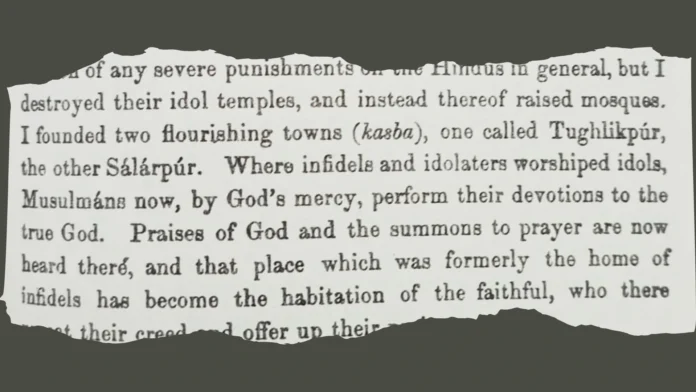
Writing in his autobiography Futuhat-i-Firoz Shahi, Firoz Shah Tughlaq, Sultan of Tughlaq dynasty who reigned over Delhi Sultanate, writes: ‘I destroyed their idol temples, and instead thereof I raised mosques. I founded two flourishing towns, one called Tughlikpur and the other Salarpur. Where infidels and idolators worshipped idols, Musulmans now, by God’s mercy, perform their devotions to the true God……and that place which was formerly the home of infidels has become the habitation of the faithful’.
In another instance, a Muslim scholar, Maulana Abdul Hai, former Rector of Nadwa, documented in one of his books that a few major mosques, including Babri Masjid in Ayodhya, Atala Masjid in Jaunpur, Jami Masjid at Etawah, Delhi (Quwwat al-Islam) etc, were built by demolishing Hindu temples and reusing their stones. Hai used phrases like ‘It is said that’ to document these 7 demolitions.
Interestingly, in the second edition of this book, it was mentioned that these exact 7 mosques were deliberately removed or replaced with vague lies (eg, ‘old decayed fort’ instead of ‘Hindu temple foundations’).
Hai was not the only one. Across India, numerous mosques preserve Persian inscriptions that proudly describe their construction on the sites of demolished Hindu temples (referred to as ‘idol temples’ or ‘but-khana’). And that these often invoke Allah, the (one who can’t be named) and Islamic figures while detailing the act as a religious triumph.
To quote one notable example is the inscription found in the Masjid at Manvi, Raichur District, Karnataka that reads: ‘Praise be to Allah that by the decree of the Parvardigar, a mosque has been converted out of a temple as a sign of religion in the reign of… the Sultan who is the asylum of Faith … Firuz Shah Bahmani who is the cause of exuberant spring in the garden of religion’.
Not just this, medieval Muslim chroniclers and poets, too, often documented temple destructions as victories of Islam over ‘infidels’, sometimes in poetic or triumphant terms. Amir Khusrau (a 13th–14th century poet and courtier under Delhi Sultanate rulers like Alauddin Khalji) described military campaigns involving temple demolitions with evident glee.
Khusrau writing in Khazainu’l-Futuh says: ‘So the temple of Somnath was made to bow towards the Holy Mecca; and as the temple lowered its head and jumped into the sea, you may say that the building first said its prayers and then had a bath. The idols, who had fixed their abode midway to the House of Abraham (Mecca), and there waylaid stragglers, were broken to pieces in pursuance of Abraham’s tradition. But one idol, the greatest of them all, was sent by the maliks to the Imperial Court, so that the breaking of their helpless god may be demonstrated to the idol-worshipping Hindüs’.
To establish rule over a civilisation, conquerors often aim to control not just land but also identity, memory and belief systems. And so, temples, in our case, weren’t smashed randomly. They were made targets primarily because they were the heart of society: spiritual hubs, cultural anchors and economic powerhouses, you can say.
Demolishing a temple wasn’t about breaking stones; it was a loud and brutal message: Your gods are weak trash. Your traditions are worthless. Your entire identity can be wiped out at any given point in time and to rub salt in the wound, they deliberately built mosques right on top of the ruins. Not for convenience but for pure symbolism. Every day, Hindus had to stare at proof of their defeat and walk past mosques built on the graves of their sacred sites.
Worse, the very invaders who systematically demolished thousands of our temples, wave after wave, finishing what the last one started, were repackaged in school textbooks as ‘Great Rulers’, ‘Brilliant Administrators’, and ‘Nation Builders’ by Marxist historians. These folks chose to raise a manufactured outrage and worked systematically to polish, censor and dilute facts.
The competing explanations that were put forward to interpret the destruction of Hindu temples and the desecration of idols during periods of Islamic rule in India are laughable. It was said that these acts of religious extremism weren’t connected with the Islamic theology and explained them instead through motives of plunder, politics or administrative necessity. Late Mohammad Habib, a Marxist history professor at Aligarh Muslim University and the father of Professor Irfan Habib, was the first who articulated this.
According to Mohammad Habib, Indian wealth was concentrated in temples, making them obvious targets for a ruthless invader seeking plunder. Habib maintained that Islam, in principle, did not sanction vandalism and that later interpretations exaggerated or misread religious motivations.
But Islam has been very clear on this.
The Quran repeatedly declares that Allah does not forgive shirk if one dies unrepentant (eg, Quran 4:48 and 4:116), describing it as a great injustice. Shirk is seen as the root of all other evils because it distorts the purpose of creation: humans exist to worship Allah alone.
From the (one who can’t be named)’s smashing of the Kaaba’s 360 idols upon conquering Mecca to early covert acts in Medina to widespread campaigns across Arabia and beyond into Zoroastrian, Buddhist and Hindu regions – this iconoclasm was a religious duty not mere opportunism.
Minhaj-us-Siraj, chief chronicler of the Mamluk Sultanate of Delhi, proudly framed conquerors like Mahmud of Ghazni as ‘idol breakers’ fulfilling divine will by demolishing temples and repurposing sites as mosques.
That Jawaharlal Nehru, a follower of his own created version of secularism, too, downplayed Mahmud’s religious motivations in his writings and portrayed Mahmud as an admirer of Indian art and architecture, while the scale and symbolism of temple destruction were minimised or omitted.
Nehru and Marxist historians tried not to relate the Islamic radicalism with the temple destruction, and Marxist historians equated Islamic iconoclasm with alleged Hindu destruction of Buddhist/Jain sites, citing isolated or dubious cases (eg, Pushyamitra Shunga persecuting Buddhists, a Pandyan king vs Jains or Harsha of Kashmir plundering temples but ignoring context like Harsha being influenced by Turushkas (Muslim Turks) or the fact that the famous Buddhist stupas and monasteries at Bharhut and Sanchi were built and continued to flourish under the rule of Pushyamitra Shunga or the massive Gupta patronage of Buddhism are rarely mentioned). Such was their fraud. One did the crime, the other was saved.
And this is how, ladies and gentlemen, interpretation gradually replaced evidence.
I say: if one is academically dishonest, it is always possible to manufacture narratives that suit an ideology. When that ideology is biased and detached from Indian realities, relying on selective quotations and half-presented facts rather than evidence, the result is precisely the kind of history often associated with Marxist historians.
Books like Sirat-un-Nabi, the first biography of the (one who can’t be named), describe what happened in the early days of Islam in Medina. Young Muslim men, inspired by Islamic teachings, would sneak into houses at night. They took the idols (statues of gods worshipped by others), carried them away, and threw them face-down into a dirty cesspit (a pit for waste). This did not stop there. According to other historical books like Tarikh-i-Tabari, the Muslims organised groups and sent them in different directions. Their job was to find and destroy the idols and images of gods.
In India, the same thing took the form of a deliberate and systematic policy under Muslim rule. Temples were not destroyed at random; they were targeted to break Hindu cultural and spiritual confidence.
Here, colonial British writers, medieval Muslim chroniclers, dhimmi Hindu scribes, post-independence political compromises and later Marxist ideologies all contributed to a narrative that presents India as lacking unity, native sovereignty and cultural continuity.
Medieval Muslim Chroniclers/Annalists, who were the court scribes (often munshis) serving Muslim rulers. Their works glorified Islamic conquests, massacres, forced conversions, temple destructions and the expansion of Darul-Islam. They celebrated violence against ‘infidels’ without moral disguise.
British scholars wrote from the vantage point of imperial rulers; they portrayed India as never having been a unified nation but a chaotic mix of diverse groups indifferent to self-rule. They emphasised invasions and conquests, downplayed indigenous resistance (framing it as mere ‘rebellions’) and legitimised Muslim rule as a precursor imperial order that brought unity, law and stability. Thus providing continuity for British rule. While some contributed positively (eg, through archaeology, linguistics, manuscript collation and evidence of ancient continuity, republics and cultural influence), their unconscious biases distorted essential points, such as minimising Hindu resistance and boosting Muslim imperial legitimacy.
Even the dhimmi Hindu writers during Muslim or British invasions internalised the rulers’ viewpoint; they show no subjective empathy for their own people or culture.
This continued after 1947. The nationalist leaders largely retained colonial frameworks, adding only a self-glorifying final chapter about their own role. This was also done during the freedom struggle to secure Muslim support, they reframed medieval Muslim kings as ‘national’ or ‘indigenous’, downplaying Hindu resistance and creating an ‘imaginary history’.
Thus, political freedom in 1947 ended foreign rule, but the deeper control over how India thinks about its own past has largely remained. Who can forget the Indira-Marxist pact? Through which, history was not merely forgotten but actively edited and facts long known were buried to sustain political narratives along with religious authority, which was used and is still being used by the Marxist historians to manage memory rather than confront truth.
Truthfully speaking, the evidence was never missing – archaeology and literary sources openly recorded the demolition of Hindu temples and the construction of mosques over them.
Hindu Temples: What Happened to Them (Volume 1) by historian Sita Ram Goel features a preliminary survey that presents a state-by-state list of nearly 2,000 mosques, dargahs and other Muslim monuments built on demolished Hindu, Buddhist and Jain temple sites. Drawn from Persian chronicles, inscriptions, ASI reports and official gazetteers, the survey is organised district-wise.
After all this brutality, a trap is thrown with the Islamo-Left saying that whatever the Hindus did with the Babri Masjid was wrong. I’ll present you some facts. Then, you can decide on if their claim should be even taken seriously or not.
Hadiqah-i Shuhada by Mirza Jan (eyewitness/participant in 1855 jihad attempt to recapture Hanuman Garhi): Describes Muslim rulers building mosques on Hindu temple sites across India specifically in Ayodhya and Faizabad, a grand mosque replaced the great Ram Janmabhoomi temple, built by Babur under Musa Ashiqan’s patronage; its called Sita ki Rasoi mosque, with the temple remnants (‘dair’) still adjacent.
Muraqqah-i Khusrawi / Tarikh-i Avadh by Shaykh Azamat Ali Kakorawi Nami: Echoes similar patterns of mosque construction on temples (eg, Mathura, Vrindavan), states Babri Masjid was built ‘in the Janmasthan temple’ under Musa Ashiqan, known among Hindus as Sita ki Rasoi.
These are just two that I specifically mentioned to make my case. There is a number of evidence available to prove that it was the Ram Temple only that existed before whatever Masjid. The evidence drawn from Muslim testimonies themselves establishes the site’s long-standing Hindu sanctity and shows that denial of the temple’s destruction is rooted in modern political evasion rather than historical uncertainty.
It clearly shows how historical narratives were shaped and reshaped over time while hiding the religious motives behind large-scale temple destruction.
Leaving you on this: Iconoclasm and temple destruction in Islam were not mere historical aberrations or acts of plunder as Marxist historians proposed but deliberate imperatives rooted in the Quran, the (one who can’t be named)’s Sunna and jealous nature of its God.
Editor’s note: This article is based on Hindu Temples: What Happened to Them (Volume 1) by historian Sita Ram Goel. The Dossier extends its sincere gratitude to all the contributors of this book, namely Arun Shourie, Ram Swarup, Jay Dubashi and Harsh Narain.
