

I use X occasionally. On 7 February, when I opened my X account, I saw a post from an account named Faarees. In his tweet, Faarees wrote: ‘Only dumb and stupid folks still believe that Muslims did the 9/11’.
Faarees had written this in response to a person’s tweet that had an image of the ‘anti-infidels’ 9/11 attack and ‘Look to Islam’ written as a caption along with it. I, as a person who has read about the 9/11 attack, felt offended, as I knew al-Qaeda was behind the mentioned attack, and who doesn’t know about Osama bin Laden, the leader of this organisation, and that Laden was a Muslim.

Then, I thought, why would this person have written so? And from here, my quest to find out the term behind my reason for getting offended got started. Luckily, Google was kind enough to take me to a news post from trtworld, where I finally got my answer. It was ‘Rage Bait’. Actually, in December 2025, the dictionary had declared ‘Rage Bait’ as its word of the year, and so they had covered the news.
Oxford Dictionary defines rage bait as ‘online content deliberately designed to trigger anger or outrage by being frustrating, provocative, or offensive, typically posted in order to increase traffic or to increase engagement with social media content or a particular web page’.
Suddenly, I had flashbacks of some other instances wherein I had seen such content, one even just a few hours ago. Where rage bait was triggered through entirely fake claims, edited or selectively cropped clips, and morphed visuals, blurring the line between genuine concern and deliberate manipulation. Sadly, in those, there were media organisations, too. And with over 90 crore Indian internet users in 2025, this shouldn’t be something with which we aren’t aware. At least I won’t like to be the one.
First, the part that gives the rage bait a structure to breathe is fake news. But, interestingly, in India, we don’t have a legal definition yet of it. However, the Australian e-safety Commissioner defines it as the fictional news created to advance particular agendas. The National Crime Records Bureau recorded in their 2020 report that the instances of ‘fake news’ increased from 486 in 2019 to 1,527 in 2020. The trend has only intensified as platforms and formats have multiplied, as reported by The Quint in September 2021.
Last month, News 24 shared an edited video clip of a conversation between Bageshwar Dham Sarkar Sri Dhirendra Krishna Shastri and an old woman on its X social media handle. The text written on the clip was: ‘Nahi bulaaunga stage par,’ Dhirendra Shastri ko mahila ne di gaali (‘I won’t call you on stage,’ the woman hurled abuse at Dhirendra Shastri).
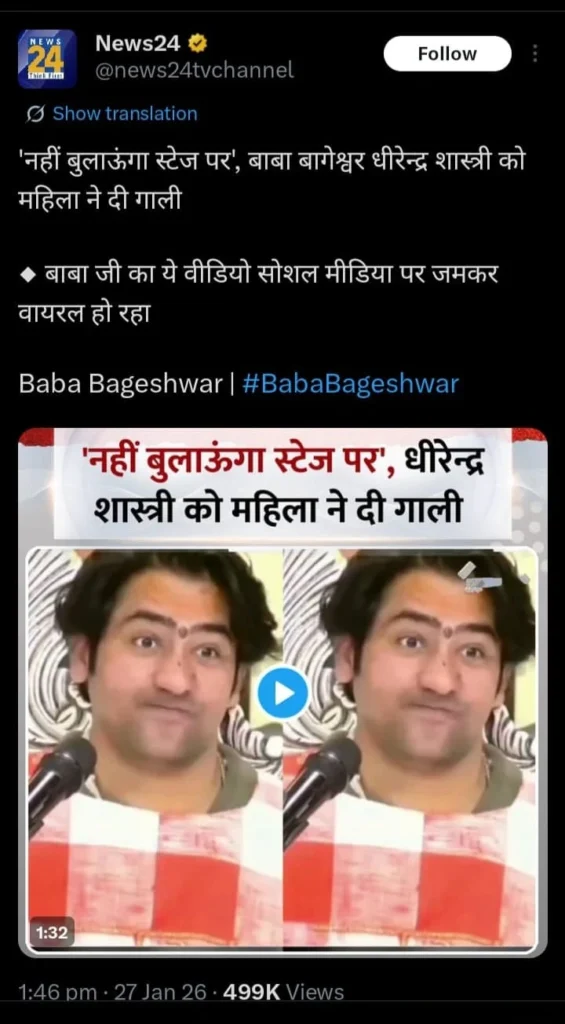
The Dossier saw the full clip of the whole conversation and found out what News 24 had claimed wasn’t the whole truth. In reality, this was a funny conversation and the woman was speaking with right as a follower of Sri Shastri and had given him even blessings at the end. Yes, Shastri did say that gali kyun de rahi maata? But, this was spoken in a funny manner, like he always does, not otherwise. But the content was shared, context was skipped, an edit was made, and an innocent was placed in a dock, and as a result, people started abusing Sri Shastri, and from Dhongi to Crazy, he was called everything.
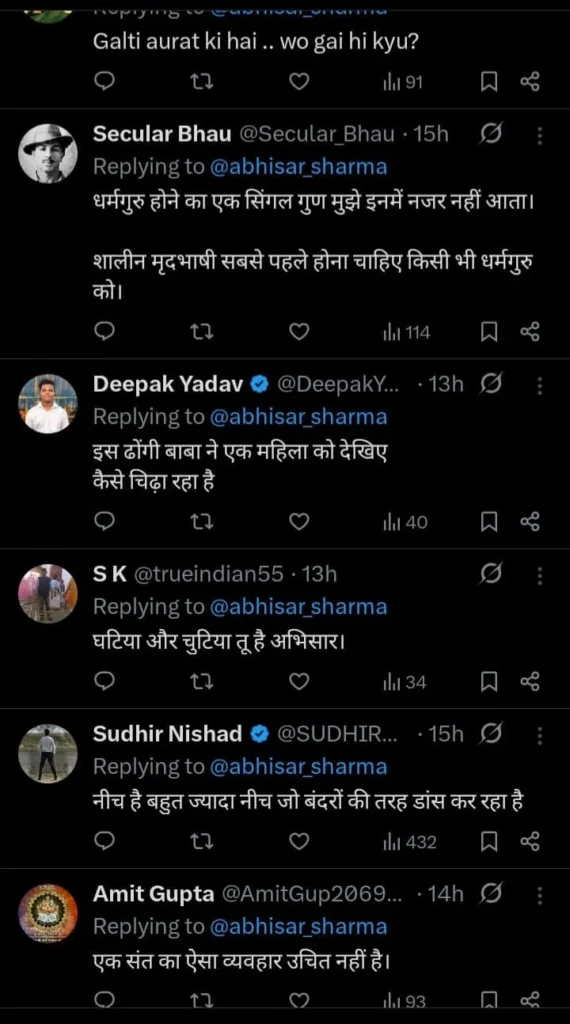
Even those who claim to be journalists were no less guilty in this. I remember the Left-wing journalist Abhisar Sharma quoting on this News 24’s post and saying: ‘Kitna ghatiya aadmi hai ye aur ahankaar dekho! Ek buzurg mahila ko kaise chida raha hai. Ye kya badtameezi hai? Dekho kitna frustrated ho jaati hai ke gaali dena padta hai. Agar di hai, toh sharmnaak (How disgusting this man is—just look at his arrogance! The way he is provoking an elderly woman. What kind of misbehavior is this? See how frustrated she becomes that she’s forced to hurl abuse. If she did, that’s shameful).
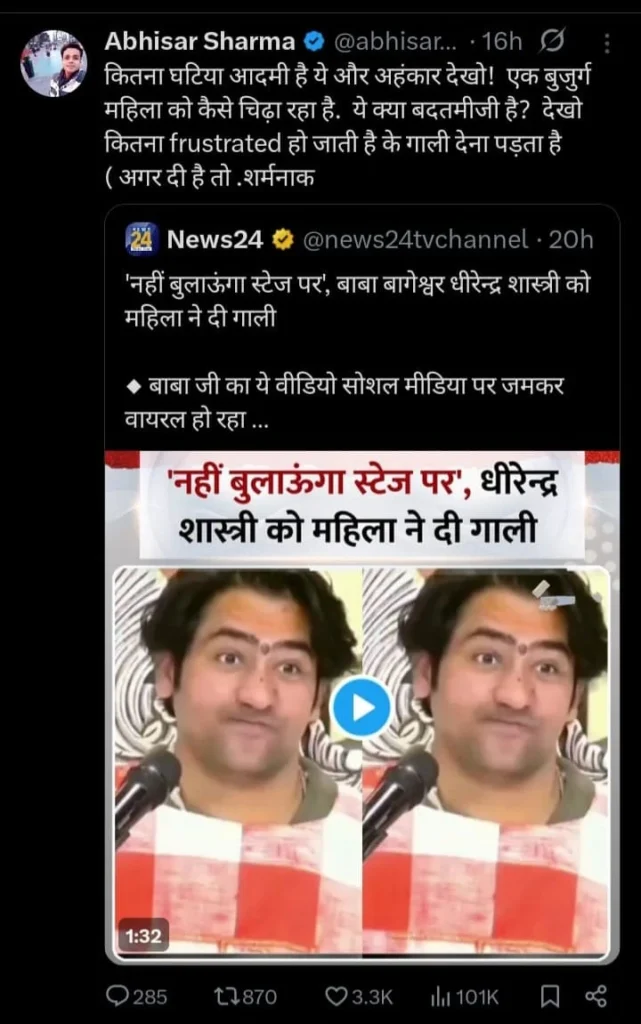
Sharma called Sri Shastri ‘ghatiya’, ‘arrogant’ and whatnot without looking at the full clip, and he is someone who has worked in the media for a long time, yet this is the kind of ‘accuracy – one of the principles of journalism’ that he adheres to.
The same happened last year with Sri Premanandji Maharaj, when he was also targeted using rage bait content, when the reality was fully different.
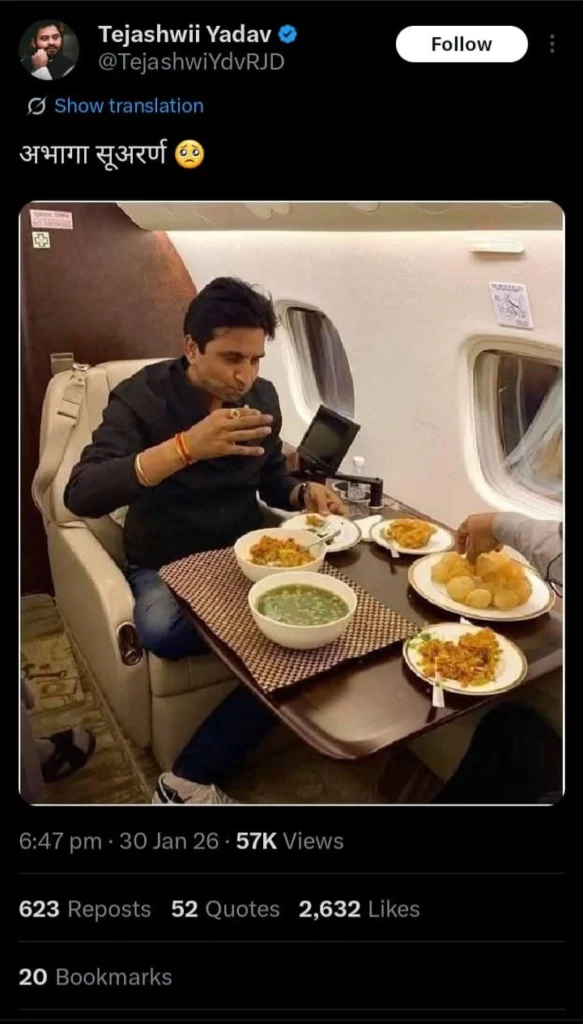
In another instance, in January 2026, a parody account of Tejashwi Yadav, Chief of Rashtriya Janata Dal (RJD), who describes himself as a small soldier of the party, wrote: ‘अभागा सूअरर्ण’ – Unfortunate Suwarna. Yadav wrote this as a caption of a pic featuring the popular poet Kumar Vishwas. In the image, Vishwas was simply having food while sitting in an airplane. But he was compared to a ‘pig’, just because he belongs to the ‘upper caste’.
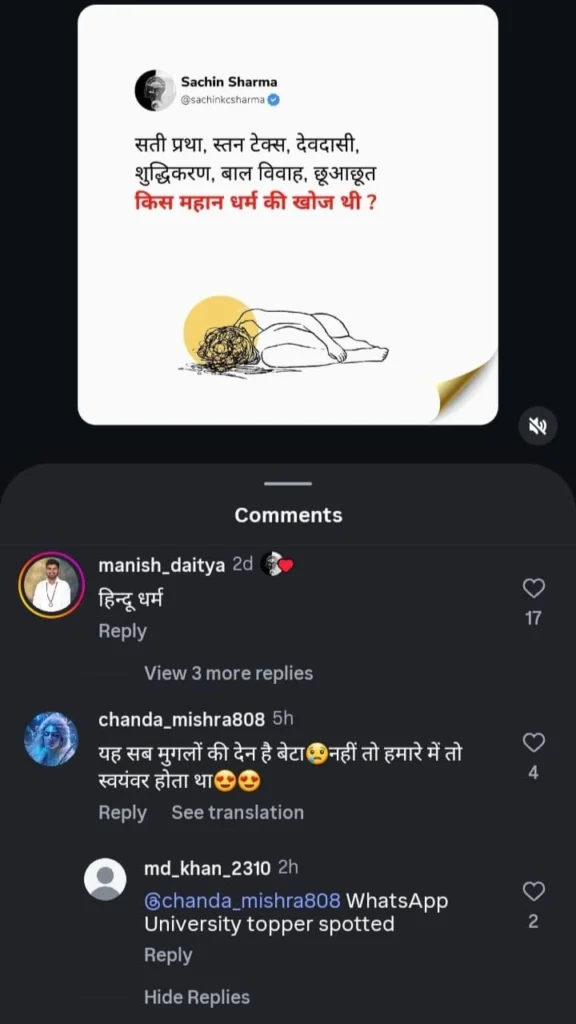
Similarly, I came across a reel on Instagram, in which a question was asked. The question was: ‘Sati pratha, stan tax, devdasi, shuddhikaran, bal vivaah, chuachoot kis mahaan dharm ki khoj thi?’ People were fast in replying by saying: Hindu Dharma. Another user, Chanda Mishra, wrote: ‘Ye sab Mughalon ki den hai beta nahi toh humaara mein toh swayamwar hota tha’ (All this is a gift from the Mughals; in our tradition, there used to be swayamvar). Funny that a Muslim named Md Khan replied to this comment and said: ‘WhatsApp University topper spotted’. And this is when his religion allows for killing the infidels, raping women, etc.
Indian School of Business and CyberPeace studies suggest that nearly half of all fake news circulating online is political in nature.
Posted a few days back, a reel that made my eyes stop was from the Indian National Congress. With over 123k likes, 1,445 comments and 25.9k shares, this reel has performed well in spreading disinformation. In it, PM Modi can be seen speaking to the Speaker of Lok Sabha Om Birla and telling him to say in the Parliament: ‘Congress ki mahila saansad mujhe maarna chahti hai’ – The women Congress MPs want to harm me. When nothing of this sort ever happened. In reality, the women Congress MPs blocked PM Modi’s seat, who was about to give a reply to the Vote of Thanks following the Presidential address on February 4. All this was done as Rahul Gandhi wasn’t allowed to break a rule of the Lok Sabha and quote from The Caravan’s essay based on an unpublished book of former Indian Chief of Army Staff General Manoj Mukund Naravane.
And I hope you all might be aware of the kind of rage bait content posted during Operation Sindoor. ATMs were being closed, airports were being shut, and so much more was spread during such a moment of national security.
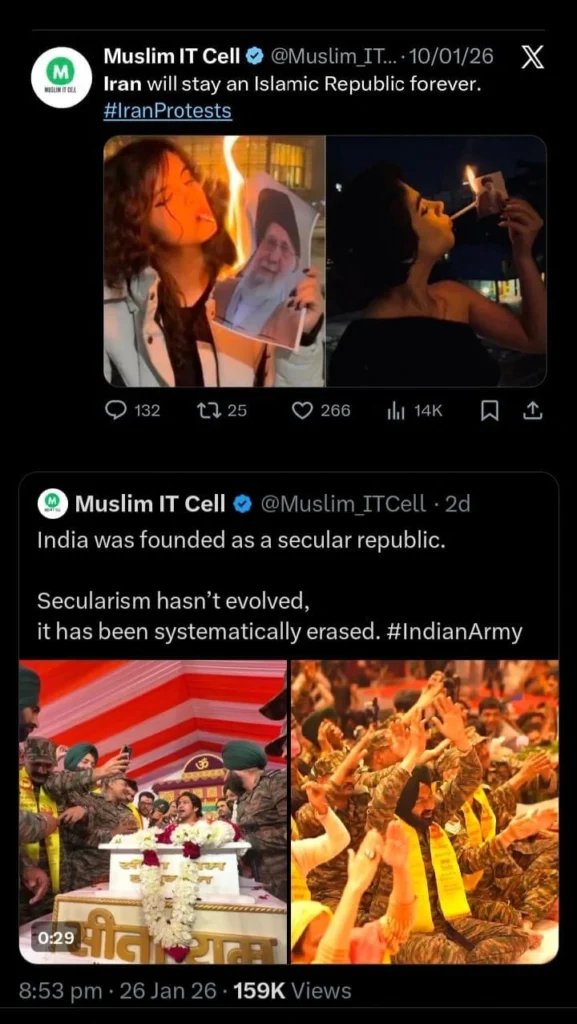
The most ironic example was of two tweets from an account named ‘Muslim IT Cell’. In one, the Cell wrote: ‘Iran will stay an Islamic Republic forever’, including two images from the brave ongoing unrest in Iran. In the other, a few Indian Army officers had gone to meet Sri Shastri, and their only fault was that they could be seen immersed in spirituality, and the same Cell wrote: ‘India was founded as a secular republic. Secularism hasn’t evolved; it has been systematically erased. #Indian Army’. When this is also nothing, but a farce.
From all these instances, we can infer that there are some ingredients that constitute rage bait. And by identifying them, the issue of rage bait can be stopped at its early stage. They are: emotional or political topic, selective editing of any video clip or message, speedy assumption without any verified source, mass sharing of that video clip or message, or screenshots.
What’s important to note is that, like the fabricated content, for example, deepfakes, this type of rage bait misrepresentation occurs when real speech is edited or stripped out of context, and audiences fill the gaps with assumptions or without any verified source that fits their fears or opinions, eventually leading them to be served factually incorrect information.
Every viral story on social media demands a choice from its readers & users. You and I can react, share, be outraged or pause, verify and think about the news. Make your sources of getting news limited. Search for an outlet that seems to be the best fit for you and stick to it.
Rage bait survives on lack of knowledge, speed and emotions. An informed reader doesn’t share or forward news blindly without verifying its authentic source. The choice is yours. In these challenging times of disinformation, always remember: ‘Rage bait spreads when thinking stops; truth survives only when readers pause’.
