

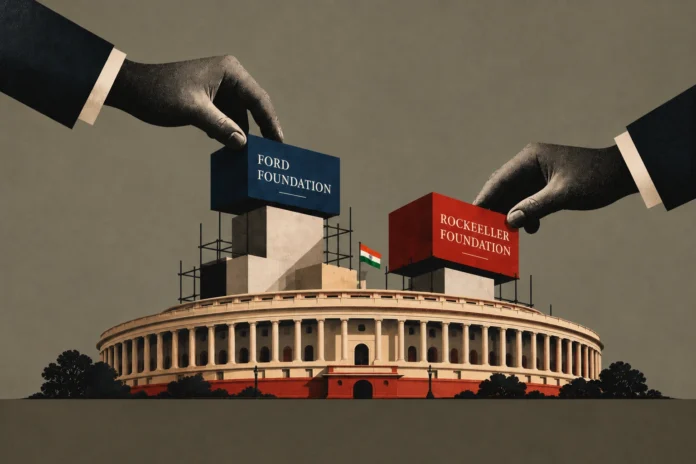
Part one closed on a state that leaked: suitcases, a mountain, a wheat berth. This part is about the money that never had to hide. It arrived with a mailing address, a mission statement and, very often, a government’s own invitation stamped on the front. The republic used what it was offered. Later governments tried, with mixed success, to meter it after the fact.
PAUL HOFFMAN, WHO HAD RUN the Marshall Plan and was then Ford’s president, visited India in 1951. A government-to-foundation understanding followed close behind him. The Ford Foundation’s first overseas office opened in New Delhi in 1952, at the invitation of Nehru’s government; decades later its address on Lodhi Estate would become shorthand for the foundation itself. Douglas Ensminger became a long-standing presence on the ground. At the mid-1960s peak, dozens of Ford consultants sat inside Indian ministries. Community Development under S.K. Dey grew into a full Union portfolio. Teacher training and extension work followed, along with a rural-university programme, the Indian Institute of Public Administration, the Indian Law Institute, and early support for the new Indian Institutes of Management at Ahmedabad, Calcutta and Bangalore. Ford’s work touched IIT Kharagpur, the Delhi School of Economics and NCAER, and ran alongside the Intensive Agricultural Districts programme. Ford’s later institutional tallies for the region run past five hundred million dollars across thousands of grants. Academic accounting of the economics and institution-building slice alone often cites more than one hundred and fifty million dollars between 1952 and 1992, frequently alongside USAID and MIT money in the same programmes.
That is brain irrigation: fellowships, faculty positions, curricula, and a cadre that went on to staff Indian finance, planning and reform for a generation. The names that pass through that world are overwhelmingly Indian policymakers, not imported foreign officers. Influence on this scale is real. It is not the same claim as Lodhi Estate writing every Five-Year Plan from behind a locked door.
THE COLD WAR STAIN on the same letterhead is also real. It needs to be kept in proper perspective, neither denied nor inflated. John J. McCloy chaired Ford from 1958 to 1965. He had already served as Assistant Secretary of War, president of the World Bank, and United States High Commissioner for occupied Germany. When he took the Ford chair, he was also chairman of Chase Manhattan and of the Council on Foreign Relations, which he led until 1970. At Ford he built an internal channel for CIA contact. He reasoned that such requests were inevitable, and better controlled at the top than handled by junior staff.
Richard M. Bissell Jr. joined Ford’s staff in 1952 and left in 1954 to become special assistant to Allen Dulles. From there he went on to run the U-2 programme and later covert action, including the Bay of Pigs. He was never Ford’s president. The Church Committee’s 1976 report found CIA money in nearly half the international-activities grants made between 1963 and 1966 by American foundations other than the Big Three. Ford, Rockefeller and Carnegie were excluded from that count. That finding describes the American foundation world as a whole. It is not an audit of any Delhi grant, and on its own terms it does not cover Ford at all. (Ford’s records on Ensminger and the early India programme, now held at the Rockefeller Archive Centre, give the fuller institutional picture.)
MIT’s Centre for International Studies, which ran a Ford-backed India economics programme, had been set up in 1951 with the CIA’s help and part of its money, as a Senate intelligence committee later confirmed. MIT cut its formal Agency link in the mid-1960s and maintained that its India work from then on was Ford money alone. India was less persuaded. It severed ties with the Centre after an Indian newspaper reported the CIA connection.
Ford created Intercultural Publications around 1952. Its journal, Perspectives USA, edited by James Laughlin of New Directions, sold American high culture to the non-communist European left. It sat in the same intellectual world as the Congress for Cultural Freedom, the subject of Part Three. After the 1967 Ramparts exposures blew the CCF’s cover, Ford became the visible cheque that replaced the covert CCF money under a cleaner name. Ensminger’s oral history records an Indian cabinet leak claiming Ford had no CIA linkage whatsoever. That claim is best read as political damage control at the moment it was made, not as an accounting of Ford’s worldwide activities.
John L. Bissell, Richard’s nephew, arrived in India in August 1958 on a two-year Ford grant to advise on cottage industries and handlooms. He stayed on, founded Fabindia in 1960 with a small personal inheritance, married Bimla Nanda, and built a firm that became far more Indian than the grant that brought him. His New York Times obituary of 3 March 1998 records that his uncle once casually asked whether he would “consider doing anything” for the Agency. John later said he was enraged by the suggestion and that it would have ruined his life if it had become known that he had agreed. The nephew who built a retail company and the uncle who ran a spy programme are, on the record, two very different men who shared a surname.
NOT ALL THE AMERICAN MONEY came through foundations, and the official track that opened the door is older than any of Lodhi Estate’s controversies. The 1950 educational-exchange agreement between the two governments created USEFI and the Fulbright programme that followed. Interest on the 1951 Wheat Loan, a separate arrangement from the later PL-480 shipments described in Part One, helped stock university libraries across the country. USIS reading rooms taught a generation of young Indians English-language modernity, largely through the pages of Life magazine. In 1970, five American Cultural Centres, in Hyderabad, Bangalore, Trivandrum, Patna and Lucknow, closed for diplomatic parity with the Soviet Union. The 1950 paper was the invitation. The 1970 closures were bookkeeping between two governments keeping score of each other’s footprint. Neither was a CIA station opening or shutting its doors.
ROCKEFELLER MONEY RUNS on a different track: the seed ledger, and an older public-health ledger alongside it. Hookworm and malaria eradication work in India predates independence by decades. A 1952 internal note already framed the country as too many people on too little land. In 1956, the memorandum that created the Indian Agricultural Program rebuilt the Indian Agricultural Research Institute into a postgraduate institution. All-India coordinated trials followed, first for maize, then for wheat and rice, alongside the National Seeds Corporation. In 1963 the Indian and Pakistani governments invited Norman Borlaug and Haldore Hanson, Ford’s representative in Pakistan, to assess their wheat programmes. India then ordered 18,000 tons of Mexican seed, the largest seed purchase in the world at the time. IR8 rice followed close behind. USAID and America’s land-grant colleges helped stand up new agricultural universities, most visibly Pantnagar, working with the University of Illinois. William Gaud, an American aid official, coined the phrase “Green Revolution” for the package.
Borlaug’s 1970 Nobel lecture called the resulting yield jump a temporary success at best: breathing space bought against what he named the Population Monster. He wanted global fertility to fall, and warned that the gain would otherwise be eaten by the growing number of mouths. He would later argue, more optimistically, that higher yields on existing farmland could spare forest elsewhere from being cleared, a land-sparing claim agronomists still debate. The population caveat was his own, not a later gloss added by critics. India’s wheat output is commonly cited as rising from about twelve million tonnes in 1965 to about twenty million by 1970. Pakistan’s harvest nearly doubled over the same window. Punjab and Haryana became the factory floor. India stopped importing PL-480 wheat ship-to-ship and eventually became a net cereal exporter. The famine conditions of 1965 to 1967 did not return.
The costs of the package are equally real and belong in the same paragraph, not a separate chapter. High-yield seed pays off only where a farmer already has water, urea and pest control. India swapped cheap wheat aid for paid fertiliser and diesel. Punjab’s water table and pesticide load are part of the later bill. The new varieties crowded out older local strains, and a narrow genetic base is, agronomically, a rust epidemic waiting for the right season. The surplus went overwhelmingly to irrigated, credit-worthy owner-cultivators.
Vandana Shiva and allied grassroots movements have long argued that the Green Revolution, and the corporate agriculture that followed it, did not merely raise yields. It restructured farming itself: a localized, biodiverse commons became an industrial system dependent on purchased inputs and increasingly answerable to corporate and philanthropic interests.
The shift to high-yielding hybrids and uniform varieties displaced thousands of indigenous landraces and millets. Those seeds were bred for response to chemical fertilizer, pesticide and controlled irrigation. In Punjab and Haryana, the package raised output, but it also drove water tables down and degraded soils. The gains accrued mainly to well-resourced, irrigated owner-cultivators. Rain-fed regions, tenants and landless labourers were left outside them. Dalit agricultural labourers—a large share of Punjab’s population and almost none of its landowners—received little of the surplus. The Minimum Support Price, never given statutory backing, became the floor the state’s farmers would not surrender. The 2020 farm laws foundered on the fear that this floor would be removed.
The counter to that package has been statute rather than slogan, and practice rather than a single campaign. The Protection of Plant Varieties and Farmers’ Rights Act, 2001, still permits an Indian farmer to save, use, exchange and sell unbranded seed without a licence. UPOV 1991, the competing international template, strengthens breeder rights and correspondingly narrows the farmer’s privilege. Community seed banks and Navdanya-style campaigns grew out of the neem and Basmati patent disputes of the 1990s, treating seed as a commons. On-farm regeneration and the registration of farmers’ varieties now function as the counter-ledger to CIMMYT material and the National Seeds Corporation.
That work has not been carried by institutions alone. Women have long been the people who actually select, dry, store and pass seed on. In Jhabua, Bhil women trained as Beej Sakhis have spent two decades keeping indigenous varieties in cultivation rather than in a cupboard; several thousand are involved across the district through village-level saving and exchange. In Banswara, women in Vaagdhara’s Saksham groups describe seed keeping as work they learned from their mothers and still do themselves—what to plant, how much to hold back for the next season, how much for food—and some say they have not bought agricultural seed for decades. In the Himalayas, women-led groups tied to Beej Bachao Andolan and later self-help seed banks revived millets and local rice, rajma and barley adapted to altitude and thin soils. The claim of seed sovereignty, in these places, is a daily practice before it is a slogan.
Under the NDA, the same contest has moved back into statute. The draft Seeds Bill, 2025, meant to replace the Seeds Act of 1966, would require commercial varieties, producers and dealers to register, put QR-based traceability on packets, and raise penalties for spurious seed. The government, including Agriculture Minister Shivraj Singh Chouhan, has said the Bill does not apply to farmers or farmers’ varieties, and that the right to grow, save, exchange and sell farm-saved seed—so long as it is not sold under a brand name—remains, in line with the 2001 Act. Farmer organisations, including the All India Kisan Sabha, read the same draft as a centralised regime: compulsory registration of what is sold, Centre-level accreditation of companies that states cannot easily refuse, and a wider opening for corporate seed at the expense of informal systems. Earlier drafts in 2004 and 2019 drew the same objection. The fight remains one of class and of statute. It is not a rerun of Charbatia.
TRACING BACK, IN 1952, INDIA ANNOUNCED the world’s first national family-planning policy. Ford and Rockefeller did not invent that political choice. They financed the machinery that carried it out. The womb became a development variable.
The Population Council, founded by John D. Rockefeller III, posted advisers to Delhi. The Khanna study in Punjab, which ran from 1953 to 1960, was an early rural contraception experiment conducted on Indian villagers. Matthew Connelly’s archival research on population control examines it in detail. Ford paid for communications work, behaviour research, fellowships, film strips, jeeps, intensive pilot districts and administrator training. Sheldon Segal advised B.L. Raina directly. Rockefeller advisers arrived at AIIMS from 1958, followed by a Ford grant to the same institution in 1962. The IUD was revived and trialled at scale. Amniocentesis, introduced as abnormality screening, soon slid toward sex selection inside prestigious hospitals. Peter King’s programme pushed condom social marketing nationwide. Ensminger pushed hard for large-scale sterilisation infrastructure as the endpoint of all this technical assistance.
Johnson tied PL-480 wheat to agricultural and population self-help targets. The World Bank later lent specifically for population programmes. Connelly’s archive work shows that the Emergency’s sterilisation targets, its coercive incentives and its contempt for consent had a long gestation inside this transnational advisory relationship. The 1976 spike, several million sterilisations under Sanjay Gandhi’s direction, was the same state apparatus foreign advisers had helped professionalise over two decades, now used by an Indian political circle for its own ends. Robert McNamara publicly praised India for moving decisively on the issue. The foundations later distanced themselves from the outcome.
Do not decipher write that the CIA ordered the sterilisation camps; the record will not support that sentence. Do not try to thinktry-to-understandwrite, either, that foreign advisers had nothing to do with the apparatus that made the camps possible; the record will not support that one either. Invited technical assistance hardened, over two decades, into state coercion. Caste was never a line item on any invoice in this story. It arrived as the plain fact of who sat inside the camp when the buses came.
That passage from invitation to coercion is the hinge of this part. Ford and Rockefeller entered India’s classrooms, laboratories, fields and clinics on an invitation Nehru’s government issued and never seriously regretted, on the whole, for the universities, the agricultural research system or the economics faculties it built.
The same invitation, extended into the far more intimate territory of the womb, produced the one clear case in this project where invited technical assistance curdled into coercion under Indian political direction.
Part Three turns from the laboratory and the classroom to the magazine, the book crate and the cinema screen. There, the same foundations and the same Agency built a different kind of infrastructure: legitimacy itself, manufactured issue by issue.