

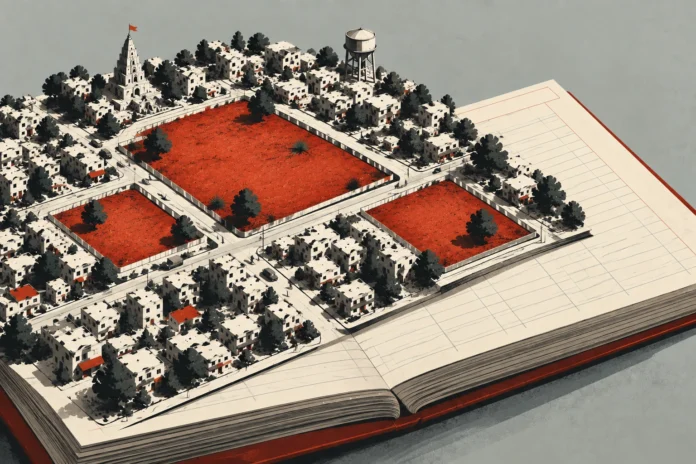
India has millions of acres of land that exist inside the boundaries of cities, towns and villages but contribute remarkably little to the economy around them.
Some belong to governments. Some belong to institutions. Some are privately owned. Some are disputed. Some are simply waiting for someone to decide what to do with them.
We usually think of land as an asset.
Perhaps we should start thinking of unused land as a political failure.
A vacant plot in the middle of a growing town is not neutral. It affects housing prices, pedestrian movement, commercial activity and the shape of neighbourhoods around it. When land remains unused for decades while a city struggles with congestion and high property prices, the question is no longer simply who owns it.
The question is whether ownership should automatically mean inactivity.
This does not mean that governments should seize private property. Property rights are protected under the Constitution. But governments can create incentives that make productive use more attractive than indefinite vacancy.
A city could maintain a public land-use inventory showing government-owned plots, their present condition, their intended purpose and the date on which they were last actively used.
This alone could produce surprising results.
Many cities spend enormous amounts constructing new facilities while valuable land already under public ownership remains unused. A municipality may search for land for a market, parking facility, public library, startup centre or community space while another government parcel sits behind a wall nearby.
The problem is often not scarcity. It is institutional fragmentation.
Different departments control different pieces of land. Nobody necessarily has responsibility for thinking about the city as a single physical system.
India’s future urban politics may therefore depend less on acquiring land and more on coordinating land.
Imagine a district-level “land exchange” where government departments can identify underused parcels and propose alternative public uses. A piece of land originally reserved for one purpose but no longer required could potentially support another public need.
Imagine temporary-use policies that allow vacant public land to become parks, markets, sports grounds, parking areas or community spaces until its permanent purpose is required.
Temporary use is particularly interesting because it challenges the assumption that every piece of land needs a permanent solution immediately.
A vacant plot does not have to remain vacant simply because its ultimate future has not been decided.
This matters enormously in smaller Indian towns.
Urban development discussions tend to concentrate on major metropolitan cities. But the next wave of transformation will also happen in district headquarters, municipalities and rapidly expanding towns.
These places often have something that major cities increasingly lack: land.
The challenge is converting land into productive civic space without destroying the character of the community.
There is also a political dimension.
Land creates power because whoever controls strategically located land influences what can happen around it.
A government that releases land for affordable housing can influence housing costs. A municipality that opens land for markets can influence local commerce. A public institution that creates a park can change an entire neighbourhood.
Land policy is therefore economic policy, social policy and political policy simultaneously.
The most interesting political promise may not be “we will build more.”
It may be “we will make what already exists work harder.”
India has spent decades thinking about development as construction. Roads, buildings, bridges, offices and housing become visible symbols of progress.
But the next stage of development may require something less glamorous.
Inventory.
Mapping.
Coordination.
Activation.
A government that knows exactly what land it owns, what land is being used, what land is underused and what land could serve a different purpose has an enormous strategic advantage.
Perhaps every municipality should therefore publish a simple annual document: its land balance sheet.
Not just financial assets.
Physical assets.
How much land does the municipality control? How much is occupied? How much is vacant?
How much is generating revenue? How much serves a public function? How much has remained unused for more than five years?
The answers could completely change local political debates.
Citizens might discover that their town does not actually need another land acquisition programme.
It may need better use of the land it already possesses.
In a country where land is becoming increasingly expensive, leaving strategically located land idle is becoming harder to justify.
The politics of the future may therefore revolve around a deceptively simple question: what are we doing with the land we already have?
That question could be worth more than another construction announcement.