

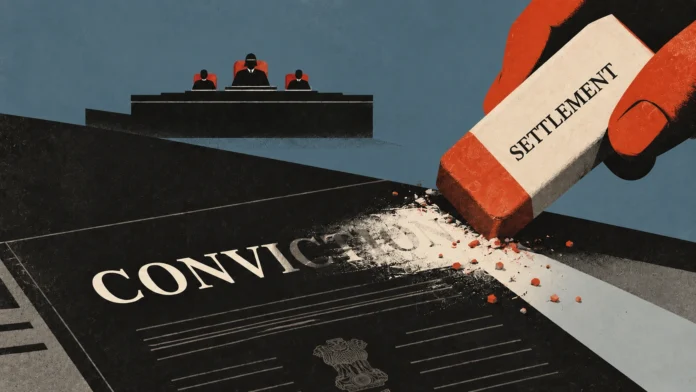
This year, the Supreme Court closed the book on a case that began twenty-one years earlier, not with a new trial, but with a private compromise struck after the accused had already been convicted and sentenced. The legal route that made this possible has been built up over more than a decade of Supreme Court rulings. Here is how it works, where it came from, and how far it reaches.
On 25 August 2026, the Supreme Court disposed of an appeal tracing back to an FIR filed exactly twenty-one years earlier, on 25 August 2005, at Police Station Abohar in Ferozepur district, Punjab (now part of Fazilka). The FIR invoked Sections 364, 325, 324 and 323 of the Indian Penal Code — kidnapping in order to murder, and causing hurt and grievous hurt. On 9 May 2012, an Additional Sessions Judge in Ferozepur convicted the accused and sentenced them to imprisonment and a fine. The conviction was on lesser charges than the FIR’s: kidnapping with intent to wrongfully confine (Section 365), and hurt and grievous hurt, each read with Section 149 on unlawful assemblies, along with rioting armed with a deadly weapon (Section 148).
After the conviction, the parties settled. The accused approached the Punjab and Haryana High Court under Section 482 of the Code of Criminal Procedure, and the High Court directed the trial court to record the complainant’s statement. Before the trial court, the complainant said the compromise had been reached through the intervention of respected community members and relatives. The complainant also said it was genuine, made without pressure or undue influence, and of their own free will. Relying on Gian Singh v. State of Punjab, the High Court then quashed the FIR and all consequential proceedings, including the conviction. The State of Punjab appealed. The Supreme Court granted leave, but a bench of Justices Prashant Kumar Mishra and Shree Chandrashekhar left the High Court’s order undisturbed. That was the end of it: State of Punjab v. Avtar Singh & Ors. (2026 INSC 934).
It’s worth pausing on how striking that outcome is. A conviction that had been recorded and sentenced was wiped away years later, once the courts were satisfied that a private settlement was genuine.
A conviction is usually treated as final. Under Indian law, it isn’t always — but the Supreme Court has spent well over a decade working out when this kind of reversal is permitted.
The power behind all of this is Section 482 of the Code of Criminal Procedure, 1973, carried forward as Section 528 of the Bharatiya Nagarik Suraksha Sanhita, 2023 (BNSS), which replaced the CrPC. Section 482 preserves a High Court’s inherent power to pass whatever orders are necessary to prevent abuse of the process of any court, or otherwise to secure the ends of justice.
That is a distinct tool from Section 320 of the CrPC (now Section 359 BNSS). Section 320 lets parties formally “compound” — settle and close — a specific, statutorily listed set of offences. Compounding is confined to that list. Offences outside it are non-compoundable, and a criminal court cannot compound them, however willing the parties may be.
Section 482 is not bound by that list. Its purpose is preventing abuse of process rather than enforcing a compounding schedule, so courts have used it to quash even non-compoundable offences. But they have generally done so only where the offence is non-heinous or predominantly private in nature, rather than a wrong with consequences for society at large. That line, private wrong versus public harm, is central to this doctrine. It was drawn across three major Supreme Court rulings over roughly a decade.
The starting point is Gian Singh v. State of Punjab (2012) 10 SCC 303, decided by a three-judge bench of Justices R.M. Lodha, Anil R. Dave and Sudhansu Jyoti Mukhopadhaya. Gian Singh’s own case had nothing to do with violence. He had been convicted by a magistrate under Sections 420 and 120B IPC for cheating and criminal conspiracy, and sought to have the offence compounded while his appeal was pending.
The Supreme Court held that a High Court’s inherent power under Section 482 is wider than the compounding power under Section 320. But it immediately drew a boundary around that width. Heinous and serious offences, or those reflecting mental depravity — the Court named murder, rape and dacoity as examples — cannot fittingly be quashed on the strength of a private compromise, because their consequences extend beyond the two parties involved. The same went for offences under special statutes such as the Prevention of Corruption Act, and for offences committed by public servants in that capacity.
Two years later, Narinder Singh v. State of Punjab (2014) 6 SCC 466 applied this reasoning to far more violent facts. A two-judge bench of Justices K.S. Radhakrishnan and A.K. Sikri considered an attack with sharp-edged weapons, prosecuted under Section 307 IPC — attempt to murder — among other charges. The Court’s reasoning is worth noting: the label Parliament has attached to an offence isn’t decisive on its own. What matters is the real severity of the injury and the surrounding circumstances, not simply which section appears in the FIR. This was an early signal that even offences carrying serious maximum sentences could, depending on the facts, still be treated as “private” enough to quash.
Narinder Singh also stressed timing. Courts can be more liberal when a settlement comes early, but should be far more careful once a conviction has been recorded, particularly while an appeal is pending.
The most detailed version of the test came in Ramgopal and Another v. State of Madhya Pradesh, decided on 29 September 2021 by a bench led by then Chief Justice N.V. Ramana, in a judgment written by Justice Surya Kant (later reported at (2022) 14 SCC 531). The facts were genuinely graphic. Over a monetary dispute, one appellant struck the complainant, Padam Singh, with a pharsa — an agricultural blade — cutting off his little finger, while the other delivered blows with a lathi.
A magistrate convicted them under Section 326 IPC, voluntarily causing grievous hurt by a dangerous weapon, along with lesser offences. In 2006, while their appeal was pending, the parties reached a compromise. The appellate court compounded the lesser, compoundable offences. It held that the Section 326 conviction, being non-compoundable, had to stand, but it cut the sentence from three years to one. On revision, the High Court agreed that Section 326 couldn’t be compounded, but reduced the sentence again, this time to the period already served.
It took one more round, before the Supreme Court, to extinguish the conviction. The Court held that the High Court had overlooked its own inherent power under Section 482, and then quashed the proceedings itself, invoking its power under Article 142 of the Constitution to do complete justice.
In doing so, the Court set out four factors that guide this line of cases:
- The nature and effect of the offence on the conscience of society;
- The seriousness of any injury caused;
- Whether the compromise between accused and victim is genuinely voluntary; and
- The conduct of the accused, both before and after the incident.
Ramgopal also settled a related question. Criminal proceedings involving non-heinous or predominantly private offences can be annulled even if the trial has concluded, or an appeal against conviction has already been dismissed. A conviction doesn’t automatically close the door. But the Court also warned that where a compromise is struck after conviction, the High Court must exercise its discretion “with rectitude.” That means weighing the circumstances of the incident, the way the compromise was reached, the nature and seriousness of the offence, and the conduct of the accused.
The Court also flagged the obvious risk running the other way. Quashing serious offences, it said, could hand an undue benefit to habitual or professional offenders who secure a “settlement” through duress, threats, social boycotts or bribes. It invoked the old maxim: “let no guilty man escape, if it can be avoided.”
Measured against these factors, the Punjab case is largely a straightforward application of the doctrine, not an extension of it. The Supreme Court’s order is brief. It quotes Narinder Singh’s point that the Section 482 power is to be used sparingly and with caution. It also reproduces Ramgopal’s passage on post-conviction compromises, including the call for rectitude. Applying both, the bench found that the incident was between individuals and was not a very heinous offence. It also found that it involved no economic offence, no NDPS contraband and no large-scale scam affecting society at large.
The order also records that the complainant’s statement was taken by the trial court, at the High Court’s direction, before the High Court quashed the case. That verification step matters, because this line of cases requires a court, not merely the parties, to be satisfied that a settlement is genuine and free from coercion. What the order does not do is engage separately with Narinder Singh’s warning about settlements reached after conviction. Beyond quoting the precedents, it does not discuss how the timing of this compromise, or the conduct of the accused, bore on the outcome.
What makes the 2026 order notable isn’t legal novelty so much as its facts: a twenty-one-year gap between the FIR and the final resolution, and a conviction that survived sentencing before eventually being quashed. It’s the doctrine working as Ramgopal described, reaching back to unwind even a concluded conviction, provided the underlying offence sits on the “private” side of the line.
One question remains: whether any of this survives the CrPC’s replacement. After the BNSS came into force, it was an open question whether the body of Section 482 case law would carry over to Section 528, given their near-identical wording. The Supreme Court touched on this, in an unrelated context, in Imran Pratapgarhi v. State of Gujarat (2025 INSC 410), decided on 28 March 2025 by Justices Abhay S. Oka and Ujjal Bhuyan.
That case involved an FIR against a Rajya Sabha MP over a poem in a video he had posted on social media, invoking BNS provisions on promoting enmity between groups. It had nothing to do with compromise or compounding. But in quashing the FIR, the Court treated Section 482 of the CrPC as the equivalent of Section 528 of the BNSS. It held that the power can be exercised even when an investigation is at a “nascent” stage. Imran Pratapgarhi does not itself decide a compromise case, but its treatment of the two provisions as equivalent gives courts a clear basis to keep applying Gian Singh, Narinder Singh and Ramgopal under the new code.
This line of cases has now been applied across a wide spread of offences: cheating and criminal conspiracy in Gian Singh, attempted murder in Narinder Singh, grievous hurt with a weapon in Ramgopal, and now kidnapping and armed rioting in the 2026 Punjab order. The core test hasn’t shifted. Is the offence heinous, and is the dispute genuinely private in character? Certain offences are ordinarily treated as unsuitable for compromise-based quashing, however sincere a later settlement may be: murder, rape and dacoity, offences under special statutes such as the Prevention of Corruption Act, and offences with a demonstrable public or societal dimension.
For litigants and lawyers, the practical takeaway is simple. A conviction — even one that has already gone through sentencing, or been upheld on appeal — isn’t always the final word. But relief isn’t automatic, either. It requires a genuinely voluntary settlement, ideally verified by a court through a recorded statement, and an offence that falls within the boundaries this line of Supreme Court rulings has mapped out.
Where those conditions aren’t met, the same body of case law is just as clear: a settlement alone will ordinarily not undo the conviction.
That covers cases where the offence is heinous, where the “compromise” looks coerced, or where the underlying wrong carries consequences beyond the two parties.
This piece draws on the text of the Supreme Court’s order in State of Punjab v. Avtar Singh & Ors. (2026 INSC 934) and the judgments it cites: Gian Singh v. State of Punjab (2012) 10 SCC 303, Narinder Singh v. State of Punjab (2014) 6 SCC 466, and Ramgopal and Another v. State of Madhya Pradesh (2022) 14 SCC 531, along with Imran Pratapgarhi v. State of Gujarat (2025 INSC 410) on the transition to the BNSS.