

This week’s news cycle is revolving around the unfortunate suicide of a young student at IIT Bombay. It has been alleged that he was caught by a professor using unfair means during an examination. The matter is currently under investigation, but, as usual, the press vultures are circling, looking for even the smallest piece of information that can be spun to prove a predetermined point – that one particular category has been oppressing another for the last 5,000 years.
This week it’s Hindustan Times. It published a report with the heading, “53 student deaths at IITs in 5 yrs, over 50% from SC, ST, OBC groups.” According to the report from 2020-21 to 2024-25, there have been 53 cases of death of student from which 45 were suicides. Of these, 29 are from OBC, STs and SCs, that is 54.7%.
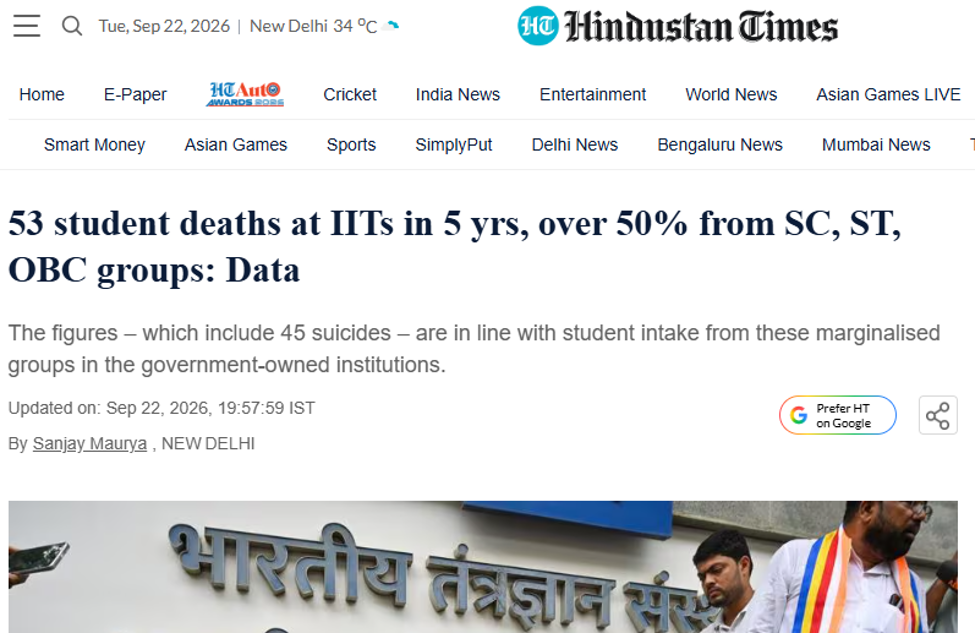
The data is not wrong, but the framing is obviously questionable. If we look at the data individually, General-category students were the single largest group, with 23 deaths, or 43.4%. But for pushing a particular agenda, this single-category figure was apparently not useful. So, three different categories- OBC, SC and ST- were combined to arrive at 29 deaths, allowing the headline to highlight the higher figure of 54.7%. That is dishonesty of the pro-max level.
The moot point is that there shouldn’t be any narrative on the deaths of students in these institutes, which HT trued to prove by pitching the numbers of GCs against others. If you compare the death rates (deaths per thousand of the population), they are almost equal for all categories.
There is another important distinction: not all 53 deaths were suicides. The data records 45 suicides and 8 unnatural deaths. According to HT’s own report, 7 of the 23 General-category deaths were classified as unnatural deaths. I am not saying why only General-category students’ deaths were classified as unnatural, while, in comparison, all 12 OBC deaths, all 7 ST deaths, and 9 of the 10 SC deaths were reported as suicides.
So, the issue is not whether the numbers are mathematically right or wrong. The issue is the framing of the numbers in the headline. The issue is what has been left out or what has not been said in the headline. Of course, this is to serve a ready-made narrative that oppression has been continuing for 5000 years. Otherwise, what could have been the motive behind a headline that combines the SC/ST/OBC figures while not mentioning that General-category students were the single largest individual category in the dataset of deaths among students?
Well, HT is not the only publication that has exclusive data. While digging deeper into the numbers, we found an old but very important set of Parliamentary data.
On 27 March 2023, the Ministry of Education, in response to Lok Sabha Unstarred Question No. 4233, provided data on student suicides in IITs, NITs and IIMs between 2018 and 2023. This was not some media report or political claim. This was official data submitted by the Government of India in Parliament. So, for looking at the context, this was important, and for dismantling the narrative that was pushing more ST/SC suicides to put the General category to blame, this was very important.
According to the data, IITs recorded a total of 33 student suicides during this period. Of these, 17 were from the General category, 9 from OBC, 6 from SC, 1 from ST and 0 from EWS. That means General-category students alone accounted for 17 out of 33, or 51.5% of all IIT suicides during this period.
Now, if we look at IITs, NITs and IIMs together, there were 61 suicides. Of these, 30 were from the General category, 18 from OBC, 10 from SC, 2 from ST and 1 from EWS. So General-category students accounted for 30 cases, while OBC+SC+ST together also accounted for 30 cases.
This is not an interpretation. These are the numbers given in the official Parliamentary answer.
So, when the entire issue of student suicides in premier institutions is presented primarily as a story of “marginalised caste groups” being disproportionately affected by the wrath of General-category students and teachers, this gets dismantled by the fact that this is not simply a caste-based problem but a student-based mental health problem. Student suicides are a much broader issue involving academic pressure, personal circumstances, mental health and institutional factors, among others.
This dismantles the narrative pushed through selective data that the percentage of deaths in a particular category, by itself, proves discrimination.
Basic statistical literacy says individual categories should be compared individually. This means A=B=C=D. What HT has done is take B+C+D and then compare that combined number against A, which is the General category in this case. This can be termed “statistical dishonesty”. When you are comparing one category against all three other categories together, it clearly shows that you want to manufacture a statistic to suit a narrative.
From the above, it is clear that HT presented selective aggregation for emotional impact, so that under the pressure of data and numbers, the guilt can be slowly shifted onto one category, rather than providing evidence of disproportionate discrimination.
If you read the 2023 Parliamentary reply, the Ministry of Education also listed several reasons behind student suicides. It said that the reasons can be academic stress, family reasons, personal reasons, and mental-health issues. We all know these kinds of pressures. So, one cannot pass the judgment that student suicides are happening because of a single-cause phenomenon which has been going on for 5,000 years.
It means one simple thing: The cause of each case has to be established on the basis of evidence. You cannot take one data point, attach a caste narrative to it, and then push a narrative which implies that there is no other established cause of a student’s death. By saying this, we are definitely not saying that there is no caste-based discrimination. That is a reality of society. But we need to minimise that, and we need to start by stating that educational institutions should not have caste discrimination. It should not simply be dismissed.
Well, in all of this, the biggest question still remains: after 50+ student deaths in premier institutes, why has the government not been able to build safeguards that can identify academic pressure, grievances, disciplinary disputes, and mental-health crises before they turn into tragedies?
At the IIT Bombay protests, the allegations and the debate around caste discrimination are understandable. But, for the record, any complaint, whether related to academic pressure, alleged discrimination, or examination practices, should be investigated properly and fairly.
Ready-made narratives are always being prepared, and press vultures are constantly on alert to pick and choose what suits their narrative. We need to be equally alert.