
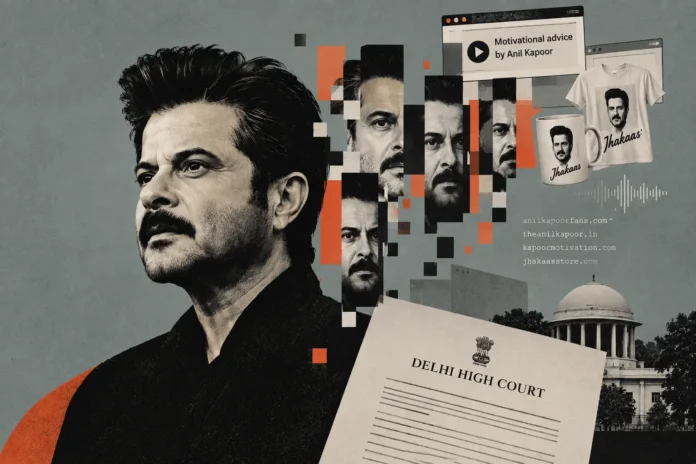
In the weeks before he sued, a fake version of Anil Kapoor was making the rounds online. Not a lookalike, not an impersonator hired for a wedding gig, but a synthetic one. Generative AI tools had lifted the veteran actor’s face and stitched it onto other actors’ bodies and animated characters. His voice, pulled from decades of film dialogue, had been cloned into ringtones and GIFs. A website was charging people money for “motivational” advice supposedly delivered by Kapoor himself. Elsewhere, someone was selling mugs, t-shirts, and stickers stamped with his image and his signature catchphrase, “Jhakaas,” as if he’d personally signed off on the merchandise line. Dozens of domain names carrying his name had been quietly registered by people who had never met him.
Kapoor had no time for the usual legal process. Indian law generally requires parties to attempt mediation before filing a commercial suit, and defendants are normally heard before a court grants relief. But the infringers were anonymous, scattered, and multiplying by the day: the kind of problem where waiting for procedure to run its course means the harm is already irreversible by the time the case is heard. So Kapoor’s lawyers asked the Delhi High Court to skip ahead, granting an emergency injunction before the other side even showed up, under Order 39 of the Code of Civil Procedure, against Simply Life India and twenty other defendants, among them e-commerce sellers, a GIF platform, three domain registrars, and an unidentified class of “John Doe” infringers still to be discovered.
On 20 September 2023, Justice Pratibha M. Singh gave them exactly that, and in doing so handed down what is now the founding order in an entirely new category of Indian law, built with no legislation behind it at all. This order didn’t invent personality rights in India. It didn’t need to. Indian courts have recognised for decades that a person’s identity (how they look, sound, and are recognised) has value, and that value belongs to them. In R. Rajagopal v. State of Tamil Nadu (1994), the Supreme Court grounded a right to control one’s own persona in the right to privacy under Article 21 of the Constitution. In Titan Industries v. Ramkumar Jewellers (2012), the Delhi High Court built on that foundation with a workable test: does the plaintiff hold an enforceable right in their own identity, is that identity recognisable from the defendant’s use, and, the sharper point, does establishing that require any proof that consumers were actually confused or deceived? Titan’s answer was no: identifiability alone does the work. Trademark or copyright registration not required.
What made the Kapoor case different wasn’t the doctrine. It was the technology it was applied to. This was the first time an Indian court had to decide whether the Titan framework, designed for stolen photographs and unauthorised endorsements, could stretch to cover something that didn’t exist when the test was written: a synthetically generated version of a person that had never actually said or done the things it appeared to.
Justice Singh’s answer was that it could, and then some. Her order restrained the sixteen defendants found to be actively infringing from using Kapoor’s face, voice, signature, or catchphrase in any unauthorised commercial context (morphed images, AI-cloned voice, merchandise, the lot) and went further, restraining “other unknown persons” from disseminating the specific pornographic and defamatory videos listed on a 44-link annexure to the order, with domain registrars ordered to lock three squatted domains and internet service providers ordered to take the listed links down immediately. It is not, on its face, an order against the world: it names defendants and it names links.
But it is written to grow. New infringing links can be added to the annexure without Kapoor having to file a fresh suit each time, which functions, in practice, as something close to standing relief against anyone who does this next. And critically, the order accepted the logic underneath Kapoor’s petition, imported straight from Titan: the harm here doesn’t depend on whether a consumer was fooled into thinking Kapoor endorsed the product. The appropriation of his identity is itself the wrong, independent of confusion. That is a meaningfully aggressive reading of publicity rights, and it is the reading that generative AI has made necessary.
A deepfake doesn’t need to trick anyone into believing it’s real to still be a theft of someone’s likeness for profit.
The court did show some restraint. One defendant, wrongly named as a domain owner, was dropped once it became clear a co-defendant already controlled the relevant domain. But the underlying finding was sweeping: personality is property, AI-generated impersonation of it is theft, and courts have the power to block it at scale, including against people who haven’t been identified yet.
Because the injunction was granted ex parte, without prior notice to most defendants, very few of them were even in the room to argue against it. But the order itself, unprompted, names the objection that matters for anyone thinking about where this law goes next: “free speech in respect of a well-known person is protected in the form of right to information, news, satire, parody that is authentic, and also genuine criticism,” Justice Singh wrote. A “world at large” style order, or anything that functions like one, risks catching legitimate expression in the same net as outright infringement. Satire, parody, commentary, and news reporting about a public figure are all constitutionally protected. An order broad enough to reach anonymous infringers everywhere is also broad enough, in principle, to chill someone making a lawful joke.
Having named the problem, the court did not so much resolve it as lean past it. Kapoor’s counsel had placed before the court an example of a doctored image, Gandhi holding a gun, used to argue that AI misuse of a public figure’s likeness was out of control. Justice Singh’s response was telling: such images, she wrote, “though, may constitute satire for some people, would be offensive to the society in general.” That is not a legal test for where satire ends and infringement begins; it’s a value judgment standing in for one, and it draws the line considerably closer to the plaintiff’s side than the free-speech language elsewhere in the order would suggest. The order draws a line between “unauthorised” and permitted use but never actually locates it, because at the interim, ex parte stage, it didn’t have to. That question was left for a final hearing, which never really came: the case settled with most defendants and ended in a mostly uncontested decree in April 2024.
What has happened since September 2023 suggests the Kapoor order wasn’t a one-off response to an unusually brazen case. It was a template, one built on top of an older one. The doctrinal groundwork actually predates Kapoor: in November 2022, Amitabh Bachchan secured a similarly sweeping ex parte order from the same court, reasoning directly off Titan Industries rather than off Kapoor, which didn’t yet exist. Kapoor’s real innovation was applying that Titan lineage specifically to generative AI (deepfakes, voice cloning, face morphing) for the first time, and it’s that AI-specific extension that later courts picked up.
Jackie Shroff went to the same court in May 2024 and secured a similar order protecting his identity, including his own well-known nickname, from unauthorised commercial use, though notably, in that case, Justice Sanjeev Narula also refused to take down a comedy sketch mocking Shroff, calling it artistic expression, which is closer to the line-drawing the Kapoor order gestured at but didn’t do. Two months later, the Bombay High Court, applying the identical logic, protected singer Arijit Singh against AI-generated cloning of his voice, with Justice Riyaz Chagla writing that the case “shocked the conscience” of the court.
That is enough, within about two years, to call it a line of authority rather than a coincidence. It has also, functionally, made the Delhi High Court the default forum for this entire emerging category of dispute, not because any statute assigned it that role, but because that’s where the doctrine was refined for the AI era, and everyone since has followed the map it drew. The docket has only grown since: Karan Johar, Abhishek Bachchan, Sri Sri Ravi Shankar, Aishwarya Rai Bachchan, Shashi Tharoor, Baba Ramdev, and Arjun Kapoor have all since filed and won some version of the same relief, several of them explicitly citing Kapoor as authority.
That is, on its own, a striking thing to watch happen in real time: a court, faced with a technology no legislature had gotten around to regulating, extended an existing doctrine to cover it, and then had that extension treated as settled practice by other courts and other litigants within months.
It’s a reminder that in India, as in a lot of legal systems, the law that governs new technology in the near term is rarely the law Parliament eventually writes. It’s whatever judges reach for first.
The Kapoor line of cases has not produced a comprehensive statute on personality rights, and it still hasn’t defined with precision where protected expression ends and actionable exploitation begins: that boundary is still being drawn case by case, sometimes contradictorily, across dozens of suits. But three years on, the picture of a doctrine expanding unchecked, its central tension permanently deferred, is no longer quite accurate on either count.
On the regulatory side, MeitY notified amendments to the IT Rules in February 2026 that bring “synthetically generated information” (the amendments’ term for deepfakes and other AI-manipulated media) within intermediaries’ due-diligence obligations for the first time: mandatory, persistent labelling of AI content, a requirement that provenance metadata can’t be stripped out, and a three-hour window to act on flagged unlawful material, down from the old rules’ thirty-six hours. It is not a personality-rights statute. It regulates platforms, not the underlying right, but it is the first time the government’s own rule-making machinery has moved on the problem the courts had been left to handle alone.
On the free-speech side, the tension Justice Singh named but didn’t resolve has now been fought out on much less sympathetic facts than Kapoor’s, and the results cut against the expansive reading. When Rajya Sabha MP Raghav Chadha sought a sweeping deepfake takedown order in 2026, the Delhi High Court refused to treat it as a personality-rights case at all once his own counsel conceded the point, and it told him plainly that “public figures must not be thin-skinned” about political satire, ordering only specific vulgar content removed rather than a blanket ban.
Weeks later, hearing a suit from Physics Wallah founder Alakh Pandey, Justice Anup Jairam Bhambhani went further, warning that personality-rights claims of the kind Kapoor pioneered “may be over broad and… susceptible to misapplication,” and that courts have a duty to stop them being used to suppress “caricature, lampooning and parody.” That is close to the opposite of where the Kapoor order’s reasoning pointed.
None of this closes the gap. It makes it visible, which is not the same thing. There is still no statute defining personality rights, no appellate ruling settling how far a Kapoor-style order can reach before it becomes a prior restraint on speech, and no mechanism for the ordinary, non-famous person targeted by the same technology to get anything like the relief a Bollywood star can secure in days.
The structural oddity is still worth sitting with: India regulates AI-enabled impersonation mostly through interim civil injunctions issued by one High Court’s bench, tested against defendants who almost never show up to argue the other side, rather than through any dedicated law or a body of considered, adversarial appellate reasoning. That’s not necessarily a failure. Common law systems have always evolved this way, doctrine first, codification later, sometimes decades later. But three years into the experiment, what’s notable is not that the tension between publicity rights and free expression got resolved. It’s that the same court that created the problem is now, case by case, the one narrowing it back down.