

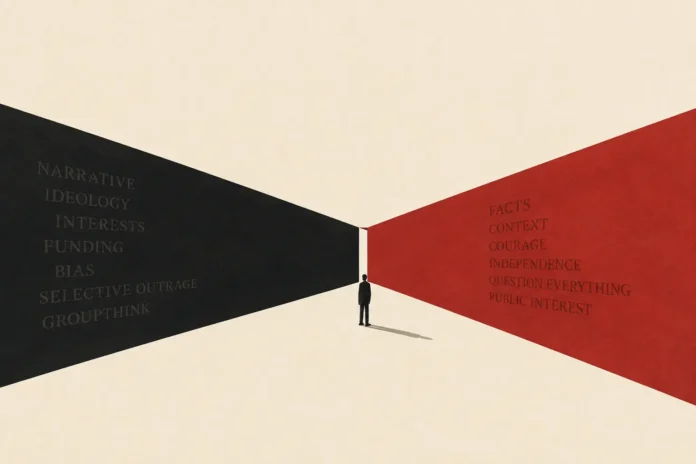
Each new electronic development widens the perimeter of American influence…communications have become a decisive element in the extension of United States world power.
– Herbert I. Schiller, Mass Communications and American Empire
As an exhausted media grad and independent researcher, take it from me: the first thing they don’t tell you in journalism and communications school is that the profession you’re entering has never, anywhere, been free. Every newsroom sits inside a structure of capital, ownership and ideology. The only honest question worth asking of any publication is not whether it is free, but whose interests it serves today and why.
Ask that question of India’s celebrated “independent” digital journalism, called ‘critical media’, and the answer is uncomfortable. Not because scrutiny of the Indian state is illegitimate; it isn’t. But because the architecture that finances a specific slice of that scrutiny looks less like scrappy watchdog reporting and more like a curated pipeline. The discomfort does not stop at the newsrooms. Ask the same question of the institutions that grade India’s press freedom and hand out its prestige journalism prizes, and the answer is just as uncomfortable, built on the same logic and fuelled by the same sources.
That logic has a name. It was given to us by people who had no stake in defending India. Herbert Schiller called it the extension of influence through communications; others have described it as soft power or structural alignment. It also sits inside a contradiction rarely taught alongside the celebration of “public-interest” journalism.
India is frequently described as a democracy under stress, yet the Constitution’s own speech protections were narrowed early: Nehru’s 1951 First Amendment added restrictions to Article 19(1)(a) that the original text never contained, and colonial-era censorship statutes on performance and cultural expression remained on the books for decades, some repealed only recently (2018). The United States, still held up as the press-freedom benchmark, carries its own long record of restricting speech in the name of security and order. No democracy examined in this piece, including those that score highest on the indexes, arrives with clean hands. The funding architecture, the indexes and the prizes did not invent selective memory. They simply professionalised it.
This piece deliberately focuses on the cluster of what the mass calls “critical,” “alternative,” or “independently funded” media (these are self-declared terms handpicked from a classic leftist handbook). It does so because a powerful majoritarian belief holds that the other side, the so-called “Godi Media”, is controlled and heavily paid, while this side is not.
Where this piece is being published is also an independent one; however, the topics “The Dossier” focuses on would more likely be branded as “Hindu Nationalist” or “Majoritarian” or worse “Anti-minority”, whereas it just focuses on the topics Maktoob Media like ‘critical media’ deliberately misses. That’s the politics of independent media and the cost of it as well. Thus the evidence that follows tests that belief against the actual record of grants, fellowships, equity investments, prize criteria and observable patterns of selection and moral weighting.
NOBODY’S MEDIA IS FREE, AND THE THEORY THAT SAYS SO WAS NEVER NEUTRAL EITHER. The part they do teach isn’t controversial. Theodor Adorno and Max Horkheimer, writing in 1944 as Jewish refugees in American exile from a Europe that had collapsed into fascism, aimed the culture-industry thesis not at the regime they had fled but at American mass entertainment, arguing that commercial culture manufactures passivity and sells even its own dissent back to the audience. Four decades later, Edward Herman and Noam Chomsky’s propaganda model argued that media manufacture consent through five filters: ownership, advertising, sourcing, flak and ideology. Ben Bagdikian tracked how ownership concentration narrowed the range of opinion in American print media.
Herbert Schiller argued that once formal colonialism ended, hegemonic powers extended their influence through the communications industries instead, an argument centred on American power and aimed at American institutions. Oliver Boyd-Barrett later gave Schiller’s thesis a working definition: media imperialism describes ownership, structure, distribution or content in one country coming under substantial external pressure from another country’s media interests, without anything close to reciprocal pressure running the other way. That definition is useful precisely because it does not require a foreign power to own an Indian newsroom outright, only that the flow of funding, training, prizes and narrative pressure runs overwhelmingly in one direction.
None of this is a right-wing insight, and none of it is wrong. It is one tradition repeating its founding habit across three generations: the Frankfurt School fleeing fascism and turning on American consumer capitalism; Schiller and Boyd-Barrett in the 1960s and 1970s aiming at the American communications empire; Herman and Chomsky in the 1980s aiming at the U.S. press’s Cold War coverage. Every generation inherited a toolkit built for corporate boardrooms and state power. None of them had much occasion to build an equivalent vocabulary for capture that runs through a foundation’s grant criteria, because in their own moment philanthropy was closer to an ally than a target.
There is an older, more useful concept sitting beneath all of them, and it comes from a writer none of them could be accused of selectively borrowing from. Antonio Gramsci, writing from a fascist prison in the 1930s, distinguished a dominant group’s power from raw coercion. He called the subtler form intellectual and moral leadership—the condition in which a population gives its consent, in his words, “spontaneously” to the direction a dominant group imposes on social life, not because it is forced to, but because that direction has come to feel like common sense rather than one interest among several. That is a more precise description of what this piece has been tracing than the propaganda model’s five filters manage on their own.
Nobody at the Independent and Public-Spirited Media Foundation (IPSMF) or the Thakur Family Foundation needs to instruct a journalist what to write. They only need the definition of “public interest” that already governs who gets funded, published, and prized to feel self-evident rather than like one worldview competing with others. Hegemony, in Gramsci’s sense, is exactly the mechanism by which a grant criterion becomes indistinguishable from professional standards. The practical effect of a one-way flow of money, training, prizes and ranking authority is therefore not merely biased coverage. It is the gradual naturalisation of a hierarchy of judgement in which the society under scrutiny is taught to see itself through the categories preferred by the society supplying them.
“Your government is the problem” becomes the default professional stance; the civilisation that funds, trains, ranks and prizes that stance remains the implicit measure of what good governance, free expression and moral seriousness look like. That is soft power operating as narrative and epistemic dominance. The theory is genuinely useful. It is also a product of who built it and which fight they were in.
Ask a media seminar to deconstruct Hindutva’s influence on Indian television, and you will get a semester. Ask it to deconstruct the donor class funding the outlets that call themselves independent, and the silence is not because no theory exists; it is because the existing theory was never built with that target in mind!
A discipline constructed across three generations to indict one direction of power was never going to notice, on its own, when the pressure started coming from the other side.
Thus, funding for media, therefore, depends heavily on ideological (political) leaning—and often on theopolitical reasons as well. Propaganda becomes subjective; so does truth. In practice, for example, progressive, left-leaning and many liberal donors, along with those whose primary concern is the protection of Abrahamic minorities of India, are far more likely to send money to outlets such as The Quint, The Wire or The Caravan, regarding them as free and independent or critical media clusters, as the harbinger of A-grade journalism; however, on the contrary, these outlets themselves frequently frame their work as minority reporting and sustained scrutiny of majoritarianism, with the bulk of that scrutiny directed at the relationship between the Hindu majority and Muslim (and to a lesser extent Christian) communities. Issues affecting Sikhs, Jains, Buddhists or other non-Abrahamic minorities receive comparatively less volume and less consistent moral framing.
The same selective emphasis appears when non-Abrahamic minorities themselves raise identity concerns. Sikh organisations in border districts such as Pilibhit have documented and protested conversions to Christianity, organising large Ghar Wapsi events and alleging foreign-funded evangelical networks. Buddhist associations in Ladakh have repeatedly demanded protection against interfaith marriages they describe as conversion pressure (Love Jihad). Sustained missionary activity among tribal (Adivasi) communities in Jharkhand, Chhattisgarh and Madhya Pradesh, and the demand by tribal organisations for delisting of converts from Scheduled Tribe status, receive thinner and more sceptical treatment than the reverse framing of attacks on Christian Adivasis. Then proud Hindu Adivasis become RSS goons. These intra-minority or non-Abrahamic minority anxieties attract far less sustained attention in the critical media clusters.
The same logic appears even more sharply in explicitly community-oriented outlets. Maktoob Media, for example, describes itself as “focused on human rights and minorities” and in practice concentrates heavily on Muslim issues. Watch that it already divides human rights and minorities. It is largely reader-funded and does not appear in the same large foundation trails that sustain the bigger English-language critical media. Donors who prioritise Abrahamic minority concerns are naturally more likely to support it; those who do not are not.
Similarly, self-described Hindu right-wingers (I still don’t understand how adherents of a decentralised civilisational tradition become right-wingers, but okay) and nationalists would rarely fund the same channels.
That is the everyday reality of how media works. It does not operate in a vacuum. It operates with political stakeholding, journalistic and editorial bias, and the worldviews, including the theo-political worldviews, of the people and institutions that pay the bills. Journalists remain free to join or leave any newsroom, but once inside they work on a tightrope set by that newsroom’s funding and ideology. Hence, there is no free media on earth, only media that serve different interests with varying degrees of transparency.
A NATION THAT WAS NEVER LEFT ALONE. Independence in 1947 ended British rule. It didn’t end the competition of external powers for influence over the new nation. The Third World became the Cold War’s second act; both Washington and Moscow treated non-aligned India as a prize. Direct colonial rule gave way to capital, cultural institutions, intelligence, and control over what a country got to read about itself.
Domestic ownership was already industrial and political from day one. Bennett Coleman, publisher of The Times of India, was acquired in 1946 by Ramkrishna Dalmia, with financing from a bank and insurer he controlled. Feroze Gandhi exposed it on the Lok Sabha floor in 1955; the Vivian Bose inquiry found public and policyholder funds had bankrolled the takeover; Dalmia was convicted; control passed to the Jains. The Indian Express was built on Ramnath Goenka’s textile fortune; Hindustan Times sat under the Birlas for decades; and the 1954 Press Commission had already noted the shift from missionary-era journalism to capital-intensive ownership.
Direct foreign ownership of mainstream Indian newspapers was deliberately restricted after Independence. Nehru’s government effectively barred foreign participation in the print press. In a confidential note dated 15 June 1956, Nehru himself recorded that some Indian newspapers had received money from foreign sources; he mentioned both communist channels and certain unofficial American agencies, while stressing that he had no definite proof and was not accusing any government. Formal foreign direct investment in newsprint was allowed only decades later, and even then, it was capped at 26 per cent with strict conditions.
Party capture needed no foreign patron either. West Bengal’s Left Front ran its own version for three decades. Ganashakti, the West Bengal CPI(M)’s house organ, was, by 1985, being directed by the state government to be stocked in public libraries. Kolkata newsrooms drew heavily from the party’s student wings, and adverse coverage was routinely softened. The cost showed twice. Marichjhapi, 1979, the police action against Bengali Hindu Dalit refugees who had settled the island on an earlier Left Front promise, has a death toll that stayed unresolved precisely because journalists, opposition politicians and even a parliamentary committee were kept off the island at the time: the official record lists under ten deaths, one widely cited conservative estimate puts it at several hundred, and survivor and local accounts collected decades later, including in Senior Journalist Deep Halder’s book Blood Island: An Oral History of the Marichjhapi Massacre history, run as high as 10000. Three years later, on 30 April 1982, 16 Ananda Marga monks and a nun were pulled from taxis and burned alive in daylight in south Kolkata. No arrest was ever made; The Statesman’s own reporting that week called the victims suspected child-lifters rather than murder victims; a judicial inquiry wasn’t ordered until 2012, under a different government. The Wire’s own 2018 piece on Marichjhapi ran under the headline “The Forgotten Massacre of Dalit Refugees in West Bengal’s Marichjhapi,” part of a series the outlet itself titled Bengal: Genealogies of Violence.
No foreign foundation funded that decades-long silence. A ruling party with a captured press did it alone.
What was specific to India was the intensity of what got layered on top. The Mitrokhin Archive records the KGB claiming to control ten Indian newspapers on its payroll by 1973, plus a press agency, and planting thousands of articles a year. Cash reached Congress coffers, Novosti overpaid CPI publishing houses, elections got subsidised. The original KGB files themselves remain largely inaccessible; only selected notes, summaries and excerpts have surfaced. What is publicly available is the book compiled from Vasili Mitrokhin’s notes, most notably The Mitrokhin Archive II: The KGB and the World (Chapters 17 and 18 deal specifically with India), which can be purchased on Amazon and other platforms.
Washington answered through the Congress for Cultural Freedom, secretly bankrolled by the CIA and exposed by Ramparts and the New York Times in 1967. In India, it ran through the Indian Committee for Cultural Freedom, led by Minoo Masani and Jayaprakash Narayan, and funded Quest, launched in Bombay in 1954 under Nissim Ezekiel, who edited it for two decades. Ambassador Galbraith criticised the magazine early on, not the shutdown sometimes claimed; it ran until 1975 and closed with the Emergency, not the funding exposure. Scholars who’ve gone through the CCF’s papers find no evidence Ezekiel or his contributors knew where the money came from; the same distinction held throughout this piece: a funding trail uncovered decades later isn’t proof of what anyone believed at the time. The Asia Foundation, another CIA conduit, ran until New Delhi shut it down.
Former R&AW chief Vikram Sood, in his book The Ultimate Goal: A Former R&AW Chief Deconstructs How Nations Construct Narratives, details precisely this Cold War contest for narrative control over India. As summarised in a 2018 Scroll.in essay drawing on the same archival material, India was treated as “mission critical” by both sides: the CIA through cultural fronts such as the Congress for Cultural Freedom and magazines like Quest; the KGB through claimed control of the payrolls of newspapers and a news agency. The essay and Sood’s account together underscore that the battle was never only about territory or alliances; it was about what Indians were allowed to read about themselves.
Every generation since has inherited the same condition under a different brand name: domestic ownership plus external ideological funding, called independence by whoever benefits from it. What’s changed isn’t the appetite. It’s the paperwork, from Cold War cash and front magazines to multi-year foundation grants, fellowships, and equity investments that now sustain the “critical” digital cluster.
THE ARCHITECTURE NOW, AND WHY FCRA MADE IT LOOK LIKE THIS. Section 3(1)(g) of FCRA bars any entity producing news from taking foreign contributions, full stop. That single clause explains the entire shape of what follows: FCRA didn’t stop foreign money reaching Indian journalism; it closed the front door and left every other one standing. A second door closed later. The 2020 amendment banned FCRA-registered organisations from sub-granting to smaller ones at all, a route that larger NGOs and intermediaries had used for years to funnel foreign money to smaller media-adjacent projects. The Supreme Court upheld the ban in 2022. Between the original 2010 bar on news entities and the 2020 ban on sub-granting, the two most obvious workarounds were both closed within a decade, which is exactly why what survives, domestic trusts, individual fellowships, equity, is what survives.
Three routes emerged:
The first: domestic trusts, immune because the money never crosses a border. IPSMF, started in 2015 with roughly Rs 100 crore from Azim Premji, Rohini Nilekani and allies, is the largest single channel. The Wire’s own funding page lists Rs 1.95 crore from IPSMF from August 2016, Rs 1.75 crore in March 2017, Rs 3.26 crore the year after, plus support for Alt News, The Caravan, Article 14 and dozens more. IPSMF says donors have no say in funding decisions, and its paramount criterion is journalism “based on facts, critical inquiry, fair, independent and in the public interest.” Take that at face value: a trust doesn’t need to whisper in an editor’s ear for its grantmaking to carry a worldview; the worldview is baked into who gets sustained support in the first place, and “accountability, civil liberties, scrutiny of majoritarianism” is not neutral vocabulary.
The second: individual fellowships, because the statute regulates entities, not people receiving stipends. The Thakur Family Foundation, a US 501(c)(3), runs public-health and civil-liberties investigative grants, which it has disclosed on its own website and in IRS filings and that were historically structured as monthly stipends. These are documented funding relationships to named individuals for named beats. One recipient, Saurav Das, received an October 2021 award “to report issues related to Public Health in India.” He initially denied it; however, his X (Twitter) acknowledgement still remains intact. Das holds only a BA in Journalism; he has no medical or public-health degree. His actual output consisted largely of RTI applications and stories on vaccine-approval data, expert committee minutes, pricing, and related process questions. He later became the named spokesperson for the Cockroach Janta Party protests in 2026. Both facts are confirmed. What isn’t confirmed, and what a 990 filing was never built to answer, is what was in his head when he wrote the funded stories. Public records also show the same foundation awarding grants to Scroll.in for public health reporting, support to The Wire for science journalism, and awards to Newslaundry and other individuals in the same ecosystem.
The third: equity, since a share purchase isn’t a “foreign contribution” under the law’s own definition. Omidyar took early equity in Scroll in 2014, became Newslaundry‘s largest shareholder by 2016, and later backed The Ken. NewsClick took roughly Rs 9.6 crore in 2018 from a US entity that the New York Times later linked to Neville Roy Singham, in a transaction structured as FDI. Six years of investigation followed; in 2026 the Delhi High Court held that even taking the allegations at face value, no offence was made out, calling it a gross abuse of process. That didn’t end NewsClick’s financial exposure. Days before the High Court ruling, the FEMA Adjudicating Authority had already imposed a combined Rs 184 crore penalty, Rs 120 crore on the company and Rs 64 crore personally on Purkayastha, finding “substantial, deliberate and systemic” violations covering Rs 9.59 crore in FDI received through what the order called misrepresented business filings, plus Rs 82.63 crore in remittances wrongly booked as service exports without the required SOFTEX filings. The criminal case collapsed. The regulatory one didn’t. The UAPA case remains separately pending.
A pure grant is illegal, so the money finds a door. And the state spends years afterwards working out whether that door was a commerce door or a conduit door.
Domestic trusts, individual fellowships, equity, all formally compliant, all sustaining the same cluster: The Wire, Scroll, Newslaundry, The Caravan, Alt News, Article 14. That ecosystem expanded more after 2014 than in any earlier decade, a chronological fact, not a verdict on the current government. This piece stays inside the English-language digital cluster whose trails are best documented, centred on Delhi and Bombay; the same questions asked of Dainik Bhaskar, Malayala Manorama and the newer Hindi and Tamil digital players, outlets whose audiences dwarf the English cluster’s, remain largely unasked here, a limitation, not proof that those ecosystems are clean.
The same philanthropic architecture also tends to operate on two tracks at once, and it’s worth naming the connection without overstating it. Grants filed under civil-liberties, public-health and accountability headings support both advocacy organisations and the digital media that cover the campaigns those organisations run. That dual-use character is institutional and thematic, a shared donor vocabulary that shapes which causes attract sustained funding on both the advocacy and reporting sides, not a proven system in which a foundation commissions a specific story about a specific protest it is separately bankrolling. The overlap is worth watching. It is not, on the documents available, evidence of direct instruction.
WHAT “CRITICAL MEDIA” ACTUALLY MEANS, AND WHO RUNS IT. Critical media, as the outlets themselves define it, is journalism that treats holding government accountable as its primary function, not one beat among several, and distinguishes itself from mainstream television and print it considers captured by advertising and ownership. Someone has to do the job Indian TV largely stopped doing after 2014, the claim goes, and that job needs funding insulated from the same pressures. Hence the architecture above.
The scene is smaller and more interconnected than the outlet list suggests, though not uniform. The Wire, founded on 11 May 2015 by Siddharth Varadarajan (formerly editor of The Hindu), Sidharth Bhatia and M.K. Venu, each holding an equal third of the Foundation for Critical Journalism, remains the largest-funded node and has received grants linked to public-health and investigative reporting, including support connected to the Thakur Family Foundation. Alt News, founded on 9 February 2017 by Pratik Sinha and Mohammed Zubair, is built around fact-checking that, in practice, functions as sustained scrutiny of the ruling party’s online ecosystem in particular. Scroll.in, launched in January 2014 by CEO Samir Patil and founding editor Naresh Fernandes, was Omidyar Network’s earliest major media equity bet in India and later received multiple public health reporting grants from the Thakur Family Foundation covering COVID testing, hospitals, the drug regulator, and vaccine-related stories. Newslaundry, launched in February 2012 by Abhinandan Sekhri, Madhu Trehan, Prashant Sareen and Roopak Kapoor (Trehan has since divested), built its identity around media criticism and has also appeared among Thakur and related grant recipients. Article 14’s managing editor is Betwa Sharma, formerly HuffPost India’s politics editor; the outlet sits firmly inside the same grant and fellowship ecosystem.
The Caravan sits apart, structurally. It is not a philanthropy-funded digital startup; it is a 1940 Delhi Press title, dormant for two decades, revived in 2009 by Anant Nath, grandson of founder Vishwa Nath, and run as a commercial magazine within a family publishing house, not primarily funded by IPSMF or Thakur money. Grouping it with the rest, based on shared politics and moral temperature, is fair. Grouping it by shared funding architecture is not.
What holds the digital-native cluster together as one scene rather than a simple list is real structural overlap: journalists writing across multiple outlets, editors appearing on each other’s boards or advisory circles, and a recurring set of Thakur, Omidyar and IPSMF-linked names appearing under several mastheads. Individual recipients, such as Saurav Das (Thakur Public Health Award, later a CJP spokesperson) and other RTI and investigative reporters, move between these platforms or publish under their own banners. That is a fact about structure, not a claim about coordinated motive.
A handful of outlets sustained by a small number of the same trusts and equity sources, staffed by people who circulate between them, does not prove a conspiracy. It does mean the pattern this piece keeps describing, shared vocabulary of public interest, aligned selection of subjects, and similar moral weighting, is closer to one institutional ecosystem operating under several names than to a dozen truly independent newsrooms that merely happen to agree.
THE RISE THAT WASN’T SUPPOSED TO HAPPEN AND WHY IT QUESTIONS THE MERIT OF DICTATORSHIP. Here’s the paradox at the centre of it all. The decade critics call India’s authoritarian turn is also, by a wide margin, the decade in which the critical-independent, digital-first Indian journalism grew faster and reached further than at any point since Partition. IPSMF was founded in 2015, a year into the present government; its grantees would spend a decade scrutinising that same government. Under the Emergency there was no adversarial media space at all, by design. Under the long Congress decades before it, critical voices existed, Quest among the elite readership, for example, but at a fraction of today’s backing and reach, because the philanthropic architecture and the phones in everyone’s pockets did not yet exist. Under Bengal’s Left Front, sustained adversarial coverage was difficult for thirty years and rarely occurred until after that government fell.
The Emergency for proportion: Whatever today’s complaints, 1975–77 remains the clearest benchmark for total state control of Indian media. Power was cut to newspaper offices for days. Roughly 200 journalists were arrested. Censors sat inside newsrooms. Doordarshan and All India Radio functioned as pure instruments of the regime. It took one government order to end an entire era of criticism overnight, because there was no funded, distributed infrastructure in place to withstand it.
That is the real difference between then and now, not that journalists no longer face arrest. Mohammed Zubair’s 2022 detention and Shahina K.K.’s decade-long UAPA case say otherwise. The difference is that no single arrest, raid or prosecution can now switch off the whole ecosystem the way a blackout could in 1975. Today’s volume of adversarial coverage and the international amplification available to it are on a different order of magnitude from that silence, not because the state stopped trying, but because the funding architecture built after 2014 made the target too distributed to fully extinguish. That difference matters more than the indexes currently weight it.
The volume of coverage and the quality of governance are different questions. But it makes the “uniquely dark” and “existential threat to press freedom” framing hard to sustain without qualification. The space for the exact media this piece has traced has never been larger than it is right now, under the government that the same media calls an existential threat.
Either that is a contradiction nobody wants to look at, or it is the honest shape of what happened: political friction and a growing critical press are not opposites. They arrive together, because friction is what the architecture was built to produce. The very existence of this expanded, funded, internationally amplified adversarial space under the government most frequently labelled authoritarian is itself the strongest empirical challenge to the claim that India has simply slid into dictatorship.
FORD, AND THE LONGEST FILE IN THE CABINET. If IPSMF and Thakur are the newer chapters, the Ford Foundation is the oldest one still open, and its India file is instructive precisely because it shows the entire arc in miniature: institution-building, then rights advocacy, then a direct collision with the Indian state, then a resolution achieved through exactly the kind of diplomatic pressure this piece’s argument would predict.
Ford opened its New Delhi office in 1952, its first anywhere outside the United States, at the Indian government’s own invitation. For decades the relationship was uncontroversial: early funding for the IIMs, the Indian Law Institute, the National Institute of Design, and agricultural research that fed into the Green Revolution. This was Nehruvian modernisation with an American cheque attached. From the 1990s the portfolio shifted toward grassroots organisations, women’s rights, gender, and eventually a global “Creativity and Free Expression” programme funding journalism, documentary film, and free-speech advocacy worldwide on a scale that, by the mid-2010s, ran into tens of millions of dollars a year.
The collision came in April 2015. India’s Home Ministry placed Ford on its security watch list (and prior-permission category), citing intelligence that the foundation had funded Teesta Setalvad’s Citizens for Justice and Peace and Sabrang Trust in ways the ministry said violated FCRA terms. Gujarat’s own report, which fed into the decision, described the foundation as abetting communal disharmony. Ford had, remarkably, operated in India since 1952 without ever formally registering under India’s foreign-exchange law—an oversight the ministry made clear it would no longer tolerate. Ford was not alone: it was one of a series of foreign foundations placed under heightened scrutiny; the Ministry later added George Soros’s Open Society Foundations and Open Society Institute to a prior-permission list, requiring MHA clearance for each donation, alongside other donors such as the Bertha Foundation.
What happened next is the part worth sitting with. Leaked emails from Hillary Clinton campaign chairman John Podesta’s personal inbox, published by WikiLeaks in 2016, showed Ford Foundation president Darren Walker running a months-long lobbying campaign to reverse the designation. He enlisted trustees, including Infosys co-founder N.R. Narayana Murthy, to intervene directly with the Indian government. Then-US Ambassador to India Richard Verma raised the FCRA action at the diplomatic level. The Home Ministry quietly lifted Ford from the watch list in March 2016—days before Prime Minister Modi’s Washington visit for the Nuclear Security Summit—after the foundation finally completed the foreign-exchange registration India had asked for all along.
Read that sequence again: an American philanthropic institution, asked by a sovereign government to register under that government’s own law, mobilised its president, a celebrated Indian industrialist on its board, and the sitting US ambassador to get the requirement lifted rather than simply complying and explaining itself in public. That is documented correspondence, not theory. It is the clearest instance in this piece of the abstract argument in practice—the diplomatic weight of a G7 government was leaned on when India tried to apply its own transparency rules to an American foundation.
India is not unique in producing this friction. Russia formally banned the Open Society Foundations outright in 2015, declaring its grants to “critical/independent media” networks and human rights work, declaring them a threat to the constitutional order. Egyptian authorities accused Ford of funding protest networks during the Arab Spring. Venezuela has denounced Ford and Open Society by name for years and legislated against exactly this kind of foreign media and civil-society funding. In 2024, Kenya’s President William Ruto publicly accused the Ford Foundation of funding the youth-led Gen Z protests against his Finance Bill and threatened to expel it. Ford denied it outright, stating it does not fund or sponsor political protests. VOA’s fact-check rated Ruto’s claim misleading, finding no evidence to support the accusation. That last case matters because it runs counter to easy conclusions: a head of state making a specific foreign-funding charge with nothing solid behind it is precisely the failure mode this piece has tried to avoid throughout—unproven claims of foreign control dressed up as certainty.
The honest reading across India, Russia, Egypt, Venezuela and Kenya is not that Western foundations are secretly directing every protest movement in the developing world. It is that the same funders, operating with the same thematic vocabulary—accountability, rights, free expression—keep colliding with the same category of state: one asserting sovereignty over its own information space and organising. Funder denies, government accuses, and the truth sits in a paper trail that takes years to surface, if it ever does. India’s decision to place Ford (and the Open Society Foundations, among others) on the watch list and the prior-permission regime simply made that collision visible in the oldest open file.
WHOSE OUTRAGE, AND WHEN. You don’t need an archive for this. In 2026, the Cockroach Janta Party’s Delhi protests over NEET-UG leaks got the Washington Post’s attention twice in weeks and cost a Union minister his job. Weeks later, near-identical irregularities in Jharkhand, under the JMM-Congress alliance, got a noticeably thinner, slower response from the same critical media clusters, and almost none internationally. The gap was noticed across the spectrum at the time, regardless of who staffed either newsroom or what anyone privately believed.
During the same period, the public faces of the Cockroach Janta Party also came under scrutiny. Founder Abhijeet Dipke (Boston University master’s in Public Relations, former AAP social media volunteer) and co-convener Ashutosh Ranka (IIT Kanpur, LSE, former McKinsey consultant) both had professional résumés that critics highlighted. Ranka was listed in early-to-mid 2026 as a consultant at the U.S.-based Kinaura Partners (formerly Global Health Visions), a firm whose partners have included the Gates Foundation and WHO; the specific profile page later became unavailable in certain search results.
Critics also circulated secondary claims (screenshots and social media posts) of a pre-protest engagement by Abhijeet Dipke with TRT World, the international English-language arm of Turkey’s state broadcaster, TRT. Turkey ranked 163rd out of 180 countries in the 2026 Reporters Without Borders World Press Freedom Index. Under President Erdoğan, the country has become one of the world’s leading jailers of journalists; RSF and other monitors have documented more than 130 journalists detained since 2014, scores of convictions for “insulting the president,” and the progressive capture of the vast majority of national media. TRT itself is widely regarded as a state mouthpiece that amplifies the government’s line and projects a pan-Islamist foreign-policy narrative abroad while independent voices at home face prosecution, media takeovers and economic pressure.
A Boston University master’s graduate in Public Relations who positions himself as a champion of free speech, expression and accountability, and who routinely criticises what he calls “Godi media,” choosing or accepting a platform from a state-linked broadcaster operating in one of the world’s more repressive media environments raises an obvious consistency question, that too in a First World country like the USA. The same figure later gave interviews to Indian and Western outlets while the CJP protests were framed around democratic rights and media freedom.
Imagine the stupidity of whining in front of a media channel that cannot even interview the political asylum seekers/refugees of that country in the USA.
Whether the TRT appearance was sought, offered, or merely claimed is secondary; the critics highlighted the contrast between the advocacy language and the choice of platform.
In mid-August 2026, Dipke was interviewed on CNN’s Amanpour programme by Christiane Amanpour. Christiane Amanpour, who interviewed Abhijeet Dipke on CNN in August 2026, has long served as a senior adviser to the Committee to Protect Journalists (having joined its board of directors in 2005). CPJ has received substantial grants from the Open Society Foundations, including $1.5 million in 2020 for its Press Freedom Centre capital campaign and additional general-support grants in subsequent years.
The associations raise legitimate questions of transparency, dual professional–activist roles and media choices; they do not, on currently available records, prove external control.
The same asymmetry of emphasis and moral temperature appears in the personnel and funding that sustained parts of the movement and the wider critical cluster. Saurav Das, an independent investigative journalist who had built a profile through RTI work, transparency reporting, and public health investigations, became a prominent spokesperson for the Cockroach Janta Party. Public records show he received a 2021 award from the Thakur Family Foundation specifically “to report issues related to Public Health in India.” He was also among those associated with the November 2025 anti-pollution protests in Delhi, and later became a public face of the CJP movement. The same foundation supported COVID-era public health reporting at outlets including Scroll.in (covering testing, hospitals, the drug regulator, vaccine trials, and contact tracing). Das has also held a Pulitzer Centre grant and co-founded the Climate Action Front. Ratna Singh, who had worked as a legal correspondent at Scroll.in, later emerged as another visible CJP spokesperson, combining legal work with the movement’s post-protest strategy. Career shifts of this kind are not unusual; what is notable is the continuity in vocabulary, accountability, civil liberties, and scrutiny of majoritarianism between grant-supported journalism and protest messaging.
Health journalism supplies a narrower illustration of the same structural pattern. Years of sustained scrutiny were directed at Indian vaccines and pharmaceutical capacity, alongside a scepticism toward Ayurveda that sometimes tipped into outright dismissal. The influence of the funding architecture is structural rather than transactional. Multi-year grants and fellowships sustain outlets and journalists who already operate inside a public-interest vocabulary of accountability, minority rights and scrutiny of majoritarianism. The result is alignment of emphasis and moral temperature across the cluster, not a documented system of payment for specific headlines.
The same asymmetry of emphasis runs through subject selection across the recognisable critical cluster—The Wire, Scroll.in, The Caravan, Newslaundry, Alt News and Article 14. It is visible in volume, framing and moral temperature rather than in any single fabricated story.
The Wire’s headline on the Ram Mandir consecration, “Delirium Over Ram Mandir: A Nation Consecrated or Desecrated?” (11 January 2024), framed the event as the triumph of religious fundamentalism over secularism. Its August 2026 anniversary piece, “In Jammu and Kashmir, Seven Years of the Project of Enforced Uniformity,” described the reading down of Article 370 as “a moment of profound constitutional fraud” and located it inside a broader “cartographic anxiety” that collapses territorial integrity and cultural uniformity into one continuous project extending to textbooks, citizenship, language and faith. Article 370 and the Citizenship Amendment Act continue to be framed in similar terms years later. Ethanol blending is routinely covered through the lens of mileage loss; the Great Nicobar project through tree counts rather than strategic maritime logic; temple corridors and related cultural initiatives through a majoritarian frame. Riots are frequently reported with the burden of guilt resting disproportionately on the Hindu majority. Caste functions as a permanent analytical category, while opposition-ruled states often receive thinner and slower scrutiny.
None of these stories is invented. The cumulative pattern of selection and moral weighting tracks the public-interest vocabulary—accountability, minority rights, scrutiny of majoritarianism—found in the grant criteria that sustain much of the cluster.
Interfaith relationships and conversion sit inside the same pattern. Critical outlets have consistently treated the broader “love jihad” claim as an unproven conspiracy used to police interfaith couples. Multiple state-level inquiries—including a Kanpur SIT ordered by the Uttar Pradesh government, Karnataka police submissions, and a 2009 Kerala DGP affidavit—found no evidence of an organised all-India movement, funding network or coordinating body. In 2020 the Centre told Parliament that no central agency had reported a single such case. That larger finding stands.
What the same outlets have given far less sustained attention to are the narrower, evidence-backed cases that do exist. The NIA’s examination of interfaith marriages in Kerala (drawn from a list of roughly 89 cases already before law-enforcement authorities) focused on a smaller subset and ultimately found no prosecutable evidence of coercion or a larger criminal design meeting its thresholds. Separate, more recent investigations occupy a different evidentiary category. The Chhangur Baba case, an active Enforcement Directorate and Uttar Pradesh ATS prosecution, has produced a documented money trail exceeding ₹100 crore across multiple bank accounts, land purchases and alleged organised conversion activities. Coverage of these specific, ongoing cases has been thinner and slower than the volume devoted to the general “love jihad is a myth” framing.
A similar relative weighting appeared after the April 2025 Pahalgam attack, in which 26 people, mostly Hindu tourists, were killed and The Resistance Front (widely linked to Lashkar-e-Taiba) claimed responsibility. The critical cluster did report the terror claim. At the same time, a noticeable strand of coverage in The Wire, Scroll and related platforms gave sustained human-interest focus to local pony handlers—both as first responders who helped evacuate the wounded and as the one local rider killed while trying to intervene. The courage and suffering of those Kashmiri Muslim pony-wallahs is factually grounded; several did risk their lives. The pattern of relative emphasis, however, is harder to miss: the ideological and organisational character of the attack received less sustained moral framing than the local rescuers. Whether this amounts to deliberate “terror-washing” is a stronger claim than the published record can fully support. That the focus shifted in volume and emotional temperature is observable.
The pattern is not only one of selective attention. It is occasionally one of outright failure. In October 2022, The Wire published a series claiming that Meta had granted the BJP’s top digital operative special powers to remove Instagram content. The emails and documents on which the reports rested turned out to have been fabricated by one of the outlet’s own sources. Two independent security researchers whose names The Wire cited as having verified the material publicly stated they had done no such thing. The outlet retracted the entire series, apologised, opened an internal review and filed a police complaint against the person it said had deceived it. Days later, police raided the newsroom and the homes of its three founding editors.
Both halves of that episode remain true at once: a serious verification failure at one of the cluster’s most prominent and funded outlets, and a state response that looked disproportionate. Neither cancels the other.
THE PRIZES WORK THE SAME WAY THE GRANTS DO. The Ramon Magsaysay Award, established in 1957 by the trustees of the Rockefeller Brothers Fund with an initial endowment and the concurrence of the Philippine government, has gone to Arvind Kejriwal (2006, for Emergent Leadership and his RTI work), Ravish Kumar (2019, for “harnessing journalism to give voice to the voiceless”), and P. Sainath. The award was created in a clear Cold War context to honour Philippine President Ramon Magsaysay, a strong U.S. ally, and to promote a model of democratic, reformist leadership across Asia.
The same architecture has not gone unremarked even by figures usually placed on the critical left. In August 2011, during the Anna Hazare anti-corruption movement, Arundhati Roy publicly pointed to the foreign funding of key participants. Writing in The Hindu, she noted that Kabir, the NGO run by Arvind Kejriwal and Manish Sisodia, had received $400,000 from the Ford Foundation in the previous three years. She further observed that three of Anna’s core members—Kejriwal, Kiran Bedi and Manish Sisodia—were Magsaysay Award winners, awards she linked to the Ford and Rockefeller Foundations. Roy described the movement as following a “copybook of the World Bank agenda” and expressed concern that NGOs funded by such foundations were mediating public policy. Kejriwal responded by asking for proof. Later it was indeed proven that Roy was correct.
The institutional pattern remains: the same foundations and prizes that shape definitions of “public interest,” “civil liberties” and “courage” also appear in the biographies of those later celebrated for embodying them.
The Shorenstein Award cites “India’s democratic backsliding” in its own language; The Caravan won it in 2023. CPJ’s citations name the pattern plainly: Neha Dixit’s 2019 award for her trafficking and police-killings reporting, Shahina K.K.’s 2023 award for being among the first Indian journalists charged under UAPA, Rana Ayyub’s 2024 CJFE honour, the same year she won RSF’s own Press Freedom Award, from the same RSF whose index calls her country’s press environment “very serious.”
Both organisations operate on documented funding architectures that track the same philanthropic and public sources examined earlier. The Committee to Protect Journalists, a New York-based 501(c)(3), reports annual revenue of roughly $12 million. Its major institutional donors include the Ford Foundation (multi-million-dollar general support, including a $2 million grant covering 2024–2026), the Knight Foundation (large capital-campaign gifts for its headquarters), the MacArthur Foundation, the Hewlett Foundation, and the Open Society Foundations (documented grants including $1.5 million for its 2020 Press Freedom Center capital campaign, $500,000 general support the same year, $750,000 in 2018 and $450,000 in 2023). High-profile journalists who have served on the board or as senior advisers at CPJ have included figures from CNN, NBC, The Washington Post and Reuters. Reporters Without Borders runs on a larger European budget (approximately €13–15 million in recent years). Public-sector grants routinely supply 50–65 % of its resources — principally from the European Union, the French Development Agency (AFD), the Swedish International Development Cooperation Agency (Sida) and the Dutch Ministry of Foreign Affairs. Private foundations (including past Open Society grants, Ford, Craig Newmark Philanthropies, and others) contribute a further 10–15%. Commercial sales of its photo albums and individual donations make up the balance. RSF states that this mix, combined with internal ethical rules, protects its independence; the same documents show a sustained reliance on Western public agencies and the familiar constellation of private foundations.
Arundhati Roy’s Booker and PEN Pinter, Gauri Lankesh’s posthumous Anna Politkovskaya Award, all of it clusters around the worldview that defines “public interest” at IPSMF and “civil liberties reporting” at Thakur. The pattern isn’t confined to India. The same architecture has elevated Venezuela’s opposition through the Sakharov Prize and the Geneva Summit Courage Award, recognised Juan Guaidó almost overnight in 2019, and honoured Chinese, Hong Kong, Iranian and Russian dissidents on the same template. An institution deciding what counts as journalistic courage performs the same gatekeeping as one deciding what counts as a fundable public-interest story. What I won’t do is take that institutional fact and claim any specific winner knew they were being used. The institution’s worldview is documented. A recipient’s inner motive is not.
A WORD ON “USEFUL IDIOTS”. Historians have never found an original source for the phrase; it seems to have been coined by Western anti-Communist writers in the 1940s and 50s, then retroactively pinned on Lenin. It’s since been recycled by every side of every fight to describe anyone whose views converge with a rival’s interests, without proving the convergence was engineered rather than sincere. Ruto’s accusation against Ford is that move wearing a Kenyan flag. Gujarat’s 2015 report on Ford is the same move wearing an Indian one.
The funding trails here are real. The institutional worldviews are documented. What isn’t documented, and what “useful idiot” was built to skip past proving, is what was happening inside a specific person’s head when they filed a specific story.
This piece therefore does not use the phrase ‘useful idiot’ against any journalist named in it. The documented facts are the grants, the prize criteria, the selection patterns and the institutional worldviews. Individual conscience remains outside what the record can prove.
WHAT FCRA ACTUALLY PROVES, AND WHAT IT CAN’T. FCRA can’t tell you what was in anyone’s head. It can tell you the shape of the workaround: equity, fellowship, remittance, every case here a variant, Greenpeace’s 2015 cancellation, Amnesty’s 2020 shutdown, CPR’s 2024 loss, Oxfam’s fight, Ford’s watch-list, NewsClick’s six years in court. Sometimes the record survives, as NewsClick’s criminal case and Ford’s watch-listing eventually did. Sometimes it doesn’t, a licence gets pulled, or a FEMA authority finds a violation and imposes a penalty, as it did against NewsClick’s ₹184 crore. Either way, what gets settled is structure, not conscience. A court can rule whether money was legitimate FDI or an FCRA workaround, and in NewsClick’s case one already has: the FEMA authority found the ₹9.6 crore FDI and the ₹82.63 crore in remittances both violated the law, even as the separate criminal case built on the same underlying facts was later thrown out as an abuse of process. It has never been asked, and couldn’t be answered, whether the journalist who benefited believed what they wrote.
FCRA is the one place in this whole architecture where “who funded this and why” is a legal question with an actual record attached, not a vibe extracted from a grant’s thematic focus. Everywhere else this piece has looked, RSF’s questionnaire, the Magsaysay jury, and a foundation’s own criteria are making the same judgment without ever having to prove it before a judge. That’s the standard worth wanting everywhere, not just where enforcement already points at outlets one side finds inconvenient.
WHAT ANYONE INTERESTED IN MEDIA ACTUALLY LEARNS FROM ALL THIS. You don’t fix a distorted information environment by shutting down critical outlets, and you don’t fix it by pretending FCRA enforcement lands evenly—it plainly doesn’t. You fix it the way you are trained to read any sourced story: who funded it, who sits on the board, whose model it resembles.
Every outlet should publish its funding terms rather than relying on the word “independent” as a substitute for disclosure. Every index should submit to the same test FCRA applies to a newsroom’s bank account: show the money, show the reasoning, let it survive scrutiny. Every prize should be examined for the worldview that decided what courage looks like in the first place.
Watch not only who funded a story, but which country’s institutional culture supplied the definition of courage, public interest and democratic health that made the story fundable and prize-worthy. Soft power does not always announce itself as power. Sometimes it arrives as the quiet, repeated insistence that one civilisation’s moral and epistemic standards are universal while another’s are permanently on trial. The funding trails, the indexes and the prizes are simply the paperwork of that arrangement.
Media has never been free anywhere. That is the only reliable gospel. Not under the Birlas, not under Ganashakti, not under the KGB’s unnamed newspapers, not under the CIA’s cultural magazines, not under a Bengaluru trust’s grant committee, not under a Florida foundation’s 990 filing, not under a New York foundation whose president had to call in an ambassador, and not under the algorithm deciding what a million phones light up with tonight.
The ranking system produces its own quiet absurdities. Both CPJ and RSF, the bodies most frequently cited when India’s press environment is graded, draw the bulk of their resources from Western public agencies and the same network of private foundations whose grant criteria shape the “critical” digital cluster examined above.
Britain has no single written constitution, yet the BBC is treated as a global gold standard. The United States runs an extensive government-funded international network (Voice of America, Radio Free Europe and others), while private prestige titles such as The Washington Post, The Guardian and The New York Times act as high-status amplifiers of preferred narratives about India. Reuters, the BBC and Deutsche Welle (DW) are held up as neutral measuring sticks. Gulf states that lack justiciable free speech rights comparable to India’s still maintain well-resourced channels such as Al Jazeera and often rank above India. India’s own public broadcasters, Doordarshan and All India Radio, carry far less international prestige—a reflection of under-funding and post-colonial hierarchy. Critics label some private Indian channels “Godi media”; the term is partisan.
Every system has state-aligned or ideologically comfortable media. The indexes rarely ask whether the culture that designs the questionnaire is itself part of the hierarchy being measured.
Watch the direction the trend is moving, because it is not slowing. India’s RSF ranking has fallen for consecutive years, sitting below Pakistan, below Jordan, and below a Qatari broadcaster that edits itself to match its foreign ministry’s line. If that continues, and nothing in the methodology suggests it will reverse on its own, do not be surprised when these same indexes rank India below regimes that would jail a journalist for belonging to the wrong sect. That will not reflect a collapse in Indian civil liberties matching the collapse in the number. It will reflect an index built by a specific institutional culture doing exactly what its own record shows it has always done.
Underneath the number sits what the Ford file shows in plain daylight: a president who had to lobby personally, a board that leaned on an Indian trustee, a government that raised the matter with New Delhi at ambassador level, all to avoid complying with a disclosure law every G7 country enforces on itself without controversy. You do not organise that kind of pressure over a country you consider a minor irritant. You organise it over a country that used to take instructions and now gives them instead.
That discomfort is not new. Every formerly colonised power that has grown too capable, too assertive, too willing to write its own rules has provoked exactly this reaction in the capitals that once wrote the rules for it. India is not graded down because its journalists are less free than Qatar’s. It is graded down because grading remains one of the last tools an older order still possesses, even as the country it grades has stopped waiting for permission. The snake-charmer image stopped being useful a long time ago. What is replacing it, in the paperwork India now forces foreign money to fill out, in the courts throwing out cases built on thin evidence, in the six years it took to establish that NewsClick’s criminal case was an abuse of process even while its regulatory penalty stood, is a country finished being described by people who never had to explain themselves to anyone.
Marshall McLuhan wrote that the medium is the message: the channel carrying information shapes what that information becomes more than the content ever admits. Every institution examined in this piece, a grant, an index, a prize, a newsroom, is a medium doing exactly that.
Choose the ones you trust with more care than their name alone deserves.