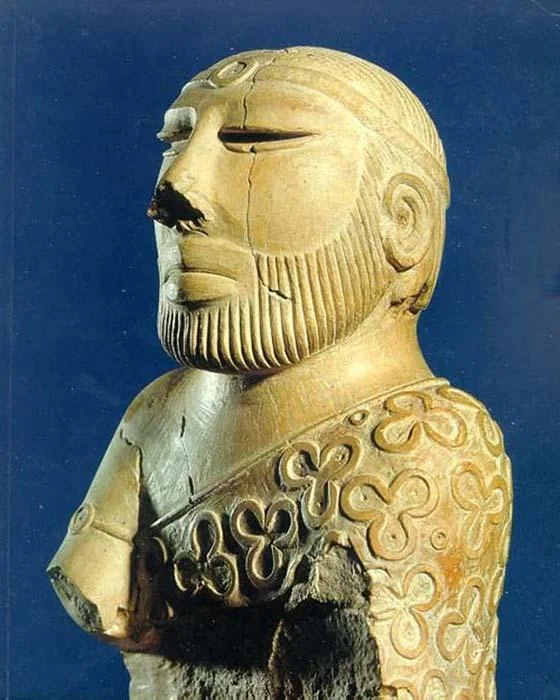
Sons of Indus, sons of nobody.There is a particular kind of tiredness that comes from watching a nation change its ancestors the way other people change their phone cases, and Pakistan has been doing this for so long now that the exercise has stopped looking like history and started looking like habit.
Jo apnā thā use gair banā diyā, Ab gairon mein baap dhoondhte phirte hain…
Call it, if you want a name for it, the fourfather problem. Not one settled lineage but four candidates for forefather, auditioned one after another across eight decades, each expected to finally supply the belonging the last one could not. What follows is the record of that search and of the fifth father, whom nobody in Islamabad has ever been willing to name, because, unlike the other four, he never actually left.
I want to keep this narrow because the story is clearer when you do not try to carry it all at once. So set aside the treaties, the diplomats, the grant money. Just look at the fathers themselves, one after another, and ask a simple question. Why does a nation need this many?
It began with a deliberate rupture. Everything that came before Islam’s arrival on this soil was placed, quite deliberately, into a single theological bin marked jahiliyat, a term used in Islamic historiography for the age of ignorance that preceded the Prophet’s message in seventh-century Arabia. Applied to Arabia, the word describes a specific tribal society before revelation. Applied to the Indus, stretched across five thousand years of subcontinental civilisation, it describes nothing real.
It borrows a theological verdict meant for one geography and pastes it onto another that had nothing to do with pre-Islamic Arabia at all. Muhammad bin Qasim, a seventh-century Arab general, was installed in the school curriculum as the first Pakistani. Mahmud of Ghazni, whose own court chronicles boast of the temples he looted, became a national hero rather than a raider. This was not organic forgetting. It was written into the 1979 education reforms under Zia-ul-Haq with the precision of a man who understood exactly what he was doing, and it worked, because three generations of Pakistani schoolchildren were taught to begin their civilisational story at the Arab conquest of Sindh in 711 and to treat everything before that date as darkness not worth mourning.
The land itself never agreed to the amnesia.
Then Arab piety got old, and the Turk arrived. When Ertugrul became a television phenomenon a few years back, it was streamed and re-streamed in Urdu across Pakistani households with a fervour usually reserved for cricket, and it was not simply entertainment. It was a father being auditioned. Central Asian steppe warriors, men who never set foot within a thousand miles of the Indus, were embraced with a warmth that no Sindhi peasant’s own grandfather, buried in that same soil for five thousand years, was ever offered.
The Ottoman connection gave the identity a kind of imperial dignity that Arab austerity could not, and for a while it filled the gap rather well.
Now the wind has shifted again, and the newest father on offer is the Indus itself. Mohenjo-daro, ignored for decades as an awkward relic that did not fit the state’s Islamic genesis story, has suddenly become fashionable. Officials pose for photographs at Taxila. Diplomats from London and Canberra are walked through the ruins with visible enthusiasm, arriving with cultural protection grants worth up to five hundred thousand pounds per project, arriving, not by coincidence, at precisely the moment the Indus Waters Treaty is under strain. The Priest-King, once a museum curiosity nobody quite knew what to do with, is now a civilisational credential. Pakistanis are told, with sudden and total confidence, that “we are the children of Indus”.
Imagine the psychological pressure on them; it is almost like that Pakistani cricket meme guy, “Ek min’t mai halat badal gaye, jazbat badal gaye… oh bhai mujhe maro”, with all those hand gestures.
THE HERITAGE THAT LEFT NO RELATIVES TO ARGUE WITH. It is worth noticing which parts of this ancient inheritance the state finds easiest to embrace, because that choice is its own kind of confession.
Gandhara’s Buddhist past, the stupas of Taxila and the serene grey schist Buddhas now touring foreign museums under Pakistani sponsorship, gets a far warmer welcome than anything Vedic or Hindu, and the reason is not subtle. Buddhism as a living faith has no community left in Pakistan to complicate the claim, and no neighbour across the border positioned to point out the contradiction. The Vedic and Hindu layer sitting underneath that same Gandharan soil has both a diminished but present community still inside Pakistan and a civilisation of more than a billion people just across the Radcliffe Line who never stopped practising the faith the state built its founding myth against.
It is a great deal easier to adopt an ancestor who left no living relatives to argue with. But who will tell you from which lineage and varna Siddhartha Gautama, the Buddha, came? Alas.
Here is another part that deserves to be said plainly, because it is where the whole performance falls apart. You cannot claim the river without claiming what it actually fed.
The 2019 study of ancient DNA from Rakhigarhi, published in the journal Science by Vagheesh Narasimhan and his colleagues, found that the population that built the Indus cities carried no steppe ancestry at all, and that the strongest genetic continuity from that population runs into the people living in the region today, on both sides of the border the map now draws.
The Sapta Sindhava that the Rigveda names, the Land of the Seven Rivers, is not a separate civilisation from the one whose seals, grammar and hymns are being claimed as heritage. It is the same one. You cannot pick up the archaeology and set down the Sanskrit that explains it, because they were never two different inheritances to begin with. They are one river, split only by a line drawn in six weeks by a man who never returned to see what he had cut through.
There is a more specific irony sitting quietly inside this same geography, one that rarely makes it into the conversation about grants and diplomats. Panini, the grammarian who gave Sanskrit its rules and whose Ashtadhyayi remains one of the most sophisticated works of linguistic analysis produced anywhere in the ancient world, was born in Shalatula, a town near Attock in what is now Khyber Pakhtunkhwa, inside Pakistan’s own borders. The man who systematised the language of the Vedas and the entire later Sanskrit intellectual tradition was not a visitor passing through this land. He was of it.
So the real choice was never between claiming Mohenjo-daro and claiming nothing. It is between claiming it honestly, with Panini and the Vedic corpus that followed him included in the inheritance, or claiming it selectively, the way a family hangs an ancestor’s portrait in the hall while denying the man ever had children.
THE RAGA IS HONOURED. THE SINGER IS NOT. This is where the cultural inversion becomes almost comic, if not so consequential. The heritage is wanted. The living culture that heritage actually produced is not.
Coke Studio is Pakistan’s most celebrated cultural export, and rightly so; its sound is genuinely extraordinary. But the raga-tal-sur structure underneath every one of its arrangements, the sapta svaras, the tabla’s rhythmic vocabulary, none of it descends from Arabia or Central Asia. It descends from the Sama Veda and from Sanskrit musical theory composed on this very soil, the same soil Panini walked on, centuries before any Abrahamic faith reached it.
The audience that streams it with pride is often the same audience that would recoil if a village folk singer used the same modal structure without a producer’s polish to make it palatable. The soil is honoured. The people who actually stayed close to it are not.
One of the most celebrated qawwalis of Nusrat Fateh Ali Khan is Mirabai’s “Sanson Ki Mala Pe”, originally a bhajan written for Bhagwan Krishna. Altering it and giving it a Sufi twist hardly changes the intent. Sufis were equally involved in this civilisational overwriting, not the sanitised image Bollywood tends to hand us. Read the history of Chishti and Ajmer, and the record on cow slaughter that has been alleged in accounts such as M.A. Khan’s. Nevertheless, the song is a legitimate form of worship the land believed in before conversion; afterward it was adopted by the Sufis in the dargahs. Nothing about the devotion changes. In some orthodox schools of thought, it is declared haram regardless.
VINASH KALE VIPRIT BUDDHI: THE FORBIDDEN DANCE. There is an old subcontinental proverb for exactly this condition. Vinash kale viprit buddhi, the wisdom runs: when ruin draws near, the intellect turns upon itself and calls poison nectar. It is usually invoked for kings who ignored every warning before their kingdoms fell, but it fits a civilisation just as well as it fits a king. What else explains a state that will honour the raga and disown the singer, that will license the archaeology and outlaw the language it was written in?
The self-sabotage is not accidental. It is the specific derangement the proverb was coined to describe, a mind so committed to its own undoing that it mistakes the undoing for strategy.
You see the identical crisis on the runway. A designer in Karachi or Lahore can send a model down an air-conditioned catwalk with movements loosely borrowed from Kathak, and it is received as high art, a sophisticated nod to ancient heritage worth photographing for the international press. Put the same Kathak, or Odissi with its documented lineage running through the temples of Odisha, on state television or in a public square, danced without the elite lighting rig around it, and the same movement suddenly reads as foreign, as something a little too close to what the state spent eighty years insisting it was not.
The dance did not change. Only the distance at which it was permitted to be admired changed. All natyashastra traditions trace back to Shiva. Some celebrated Pakistani dancers have even claimed Odissi and Kathak were born in Pakistan, stressing lineage through Mughal courts and the mujra ghars of Heeramandi, when these were temple dance forms, a legitimate mode of worship, bent out of shape by successive theopolitical invasions. Meanwhile, contested historians continue to argue, without much archaeological backing, that the Pashupati seal has nothing to do with Shiva at all, an argument that keeps getting dismantled by the archaeologists who actually study the seal.
And then there is the label itself, the plainest evidence of all. Say the words “South Asian” to a Pakistani official in a diplomatic setting a decade ago, and the correction would arrive almost instantly. We are not South Asian, the argument went; we are closer to Central Asia, closer to the Gulf, closer to anywhere that is not the subcontinent standing right there in the mirror. Now the same establishment wears “South Asian” proudly, insisting instead that India borrowed the civilisational template from Pakistan and not the other way round.
It is the same rhetorical move as insisting Palestine always existed and that Jesus was Palestinian. The Quran refers to Israel as Bani Isra’il dozens of times; Ishmael’s descendants settled in Arabia while Isaac’s descendants, the Israelites, were given Canaan. The book never mentions Palestine, and it never mentions Pakistan, because neither existed at the time. Both are theopolitical projects that emerged centuries later, out of Arab-Islamic expansion in one case and British colonial partition in the other.
It is a strange kind of denial for a nation currently asking British and Australian diplomats to accept it as the custodian of a five-thousand-year-old South Asian river civilisation. You cannot claim the Indus as your deepest inheritance while flinching at the geographic category the Indus actually sits in.
THE FIFTH FATHER NOBODY WILL NAME. Every audition so far has been about which distant lineage to adopt. There is a fifth father Pakistan has never had to audition, because he was born of this soil already, and instead of adopting him the state has spent eight decades making sure he does not come home.
The 1941 census, the last one taken before the map was redrawn, recorded Hindus at roughly 14.6 per cent of the population of what would become West Pakistan, and Sikhs at close to 8.8 per cent of Punjab alone, a combined community running into several million people who had lived on that soil for as long as anyone could document. By the first Pakistani census in 1951, the Hindu share had collapsed to about 1.6 per cent. The 2023 census puts it at 2.17 per cent, roughly 5.2 million people in a country of more than 240 million, and the Sikh population, once more than two million strong in the Punjab region alone, is now estimated in the low tens of thousands.
This is not the ordinary demographic drift a country experiences over eight decades. It is one of the fastest disappearances of a native religious majority anywhere in modern history, set off by Partition violence and mass flight, and sustained since by forced conversion, abduction and the quiet arithmetic of a state that never intended for the numbers to recover.
What could not be removed from the census rolls was instead removed from the built landscape. The Evacuee Trust Property Board, the government body charged with administering the temples and gurdwaras left behind in 1947, today holds more than 1,100 Hindu temples and over 500 gurdwaras on its books. A survey by the All Pakistan Hindu Rights Movement found that of the 428 Hindu temples it traced, barely twenty remain in use as temples.
“You cannot claim descent from a five thousand year old river civilisation while its living descendants are reduced to two per cent of the population, and their remaining shrines are used to hang meat.”
The rest tell their own story better than any commentary could. The Basuli Hanuman Mandir in Lahore’s Anarkali quarter, built in the early twentieth century, was filmed in 2024 with public toilets installed inside its prayer hall. The Varun Dev Mandir on Manora Island in Karachi, close to a thousand years old and nominally still under the Pakistan Hindu Council, has been repurposed as a tourist toilet block. The Sitaram Temple in Ahmadpur Sial, a century old, was converted into a meat store. Gurdwara Sri Damdama Sahib in Rawalpindi’s Raja Bazaar, built in 1876 by Baba Khem Singh Bedi, now has an abattoir and beef shops operating at its main entrance, with more than a dozen other shops trading out of its former prayer rooms. In 2026, the 125-year-old Gurdwara Sri Guru Singh Sabha Sahib in Farooqabad, a site tied to the Singh Sabha reform movement, was demolished outright by a local businessman without a permit, prompting a formal protest from New Delhi that Islamabad’s own officials could not really contest.
None of this is offered as score settling. It is offered because it is the plainest possible answer to the question this piece keeps circling back to. A civilisation that intended to hold its inheritance intact does not let the temples of its own soil become toilets and butcher shops while its diplomats pose for photographs at Mohenjo-daro three hundred miles away.
The umbilical cord was not severed once, cleanly, in the confusion of 1947. It has been cut over and over since, in census after census and temple after temple, and the wound is still fresh enough that Pakistan’s own Supreme Court has had to intervene more than once to ask why there are no idols left in the idol houses it is supposed to be protecting.
I do not think any of this is stupidity, and I do not think it is even mostly cynicism, though there is plenty of that too, particularly as the Indus Waters dispute has sharpened every motive behind the recent visits to Taxila. I think it is closer to grief that has never been allowed to finish. A population was told, generation after generation, curriculum after curriculum, that the land beneath its feet did not belong to it until Islam arrived to redeem it, and that kind of instruction does not simply vanish because a government now finds the ruins useful for a photograph.
The land itself never agreed to the amnesia. The rivers kept running under whatever name the decade’s politics demanded.
Some of this instinct to fracture history into sealed, hostile eras did not originate in Pakistan at all. James Mill, who had never set foot in India when he wrote his History of British India in 1817, divided the entire subcontinental past into a Hindu period, a Muslim period and a British period, each walled off from the others as though a living civilisation could be filed into administrative boxes. Two centuries of scholarship have since dismantled that scheme, because civilisations that manage to hold together do not actually work that way. Iran, for all its own revolutionary rewriting, still calls its pre-Islamic kings by name and teaches Ferdowsi’s Shahnameh in its schools. So do Turkiye and Egypt. Only Pakistan had to be the true Muslim, among all the convenient cosplayers.
Pakistan took Mill’s colonial partition of time and did something no coloniser had quite dared to do. It did not merely periodise the Vedic and Hindu past. It amputated it, and then called the amputation a founding.
THE ONLY NATIVE SON. Here is the strange coda to the whole search. After eight decades spent importing forefathers from Arabia, Anatolia and now the Indus valley, and after two centuries of dismembering its own Vedic inheritance, Pakistan does actually have one invention it can call entirely its own. Not the Ghaznavid raider, not the Ottoman sultan on a streaming service, not even the borrowed Priest-King of Mohenjo-daro. Its one genuinely indigenous export, the one thing it did not need to adopt from somewhere else, is the state-sponsored jihadist apparatus it built from scratch and has run, with only brief pauses for diplomatic cover, since at least the 1980s.
Lashkar-e-Taiba’s role in the 2008 Mumbai attacks that killed 166 people was laid out in granular detail through American operative David Coleman Headley’s own account to investigators, describing reconnaissance work conducted alongside serving ISI officers. Admiral Mike Mullen, then chairman of the United States Joint Chiefs of Staff, told the Senate Armed Services Committee in September 2011 that the Haqqani Network functioned as a veritable arm of Pakistan’s Inter-Services Intelligence agency. Pervez Musharraf, a former army chief and president of Pakistan, said much the same in his own memoir, describing the training and infiltration of militants across the Line of Control as a matter of deliberate state policy rather than rogue activity anyone needed to apologise for.
None of that required a borrowed ancestor. It required a doctrine, and Pakistan wrote its own.
That doctrine never stayed confined to Kashmir’s mountains. It came home, and it came home explicitly, into the ethnic cleansing charted through this piece: the census collapse of Hindus and Sikhs, the temples turned to toilets and meat shops, the forced conversions that advocacy groups including the National Commission for Justice and Peace and the Pakistan Hindu Council put in the hundreds every year.
A state does not produce an external jihad and an internal demographic vanishing act by accident, using entirely unrelated machinery. It produces both from the same root, the conviction, stated as recently as April 2025 by the country’s own army chief, that Hindus and Muslims are, in General Asim Munir’s own words, fundamentally different in religion, custom, tradition, thought and ambition. He said it first at the Overseas Pakistanis Convention in Islamabad on the sixteenth of April, then repeated it days later at the passing-out parade in Kakul. Within a week of that first speech, gunmen killed twenty-six tourists at Baisaran in Pahalgam, in an attack whose doctrinal lineage runs straight back through the same two-nation logic Munir was reciting from the stage.
It has now been just over fourteen months since a serving Pakistani army chief told his own countrymen, in so many words, that the fifth father this piece keeps returning to does not merely belong to a different household. He belongs, in the General’s own formulation, to an entirely different civilisation.
Pakistan spent nearly eighty years trying to convince the world it descended from Arabs, Turks and finally the Indus itself. Its own army chief just admitted, without quite meaning to, the one thing it actually built by itself. Not a civilisation. A wall, and the machinery to keep enforcing it.
The honest reckoning would not require choosing a single father at all. It would require admitting there were always several, that Arab, Turk, Persian and Indic layers can sit together in one civilisational memory without any of them needing to erase the others, the way Egypt holds its pharaohs and its mosques without treating one as a threat to the other. Pakistan has not tried that. It made a recent, half-hearted attempt to change some road names and backed down within days under threats from hardliners.
The hardliners are not really the aberration here. Pakistan is an ideological state, and ideological statehood carries its own limitations. The belief on which Pakistan was built would never quite allow it to accept its own Hindu-Vedic past.
پوچھتے ہیں وہ کہ غالب کون ہے کوئی بتلاؤ کہ ہم بتلائیں کیا Pūchhte haiñ vo ki ‘ġhālib’ kaun hai Koī batlāo ki ham batlā.eñ kyā They ask, “Who is Ghalib?” Someone tell me, what should I even say? — Mirza Ghalib
Eighty years in, and Pakistan is still being asked the same question, in the same helpless register. So it runs through fathers one by one, hoping each new one will finally supply the belonging the last one could not, while the fifth father, the one who was never a visitor at all, waits in a temple that is now a toilet or a gurdwara that is now a meat shop, for an invitation eighty years of habit suggest is not coming.
A Shaw is a communications graduate and an independent researcher working at the intersection of narrative sovereignty, civilisational history, and national security. Shaw is the author of One Year After Baisaran Valley: Abu Musa Kashmiri's Confession and Its Doctrinal-Strategic Implications for India (2026).