

Every year on 6 December, many claim that the Ayodhya Temple verdict was delivered on the basis of religion rather than facts.
The assertion itself is difficult to sustain because the Supreme Court (SC), in its unanimous judgment, stated:
“As regards the inner courtyard, there is evidence on a preponderance of probabilities to establish worship by the Hindus prior to the annexation of Oudh by the British in 1857. The Muslims have offered no evidence to indicate that they were in exclusive possession of the inner structure prior to 1857 since the date of the construction in the sixteenth century.”
The central question before it was not whose religious belief was stronger, but who had the better legal claim to the disputed property on the basis of evidence. To understand why the court approached the dispute in this manner, it is necessary to begin with the origins of the controversy itself.
In her book The Battle for Rama: Case of the Temple at Ayodhya, Historian Meenakshi Jain traces references to the Ram Janmbhoomi across centuries—from Abul Fazl’s Ain-i-Akbari, which describes Ayodhya as the birthplace of Bhagwan Ram, to the 1723 Persian sanad referring to the site as Janmbhumi, Joseph Tieffenthaler’s eighteenth-century account describing a temple at the birthplace, nineteenth-century Muslim petitions using the term Masjid Janmsthaan, and archaeological findings discussed later in the book.
Coming to the arguments made, the Muslim parties argued that the disputed structure was constructed in 1528 during the reign of the Mughal emperor Babur by his commander Mir Baqi, and that it had continuously functioned as a mosque.
The Hindu parties, on the other hand, maintained that the site had always been regarded as the birthplace of Bhagwan Ram and that a pre-existing Hindu temple had been demolished before the disputed structure was constructed.
The SC did not simply accept either version because it was widely believed. Instead, it examined whether documentary evidence, archaeology, historical writings, traveller accounts, revenue records, official records and witness testimony supported either claim.
The dispute itself long predated modern political debates and had already entered the courts during the colonial period.
The judgment records that communal clashes occurred around the disputed structure in 1856–57. To prevent further violence, the colonial administration built a grill-brick wall dividing the premises into two parts. Muslims continued to offer prayers in the inner courtyard, while Hindus worshipped in the outer courtyard, where structures such as the Ram Chabutra and Sita Rasoi were situated.
This arrangement did not settle ownership but merely separated the areas used by each community to maintain public order.
The first formal legal challenge came in 1885, when Mahant Raghubar Das approached the Faizabad court seeking permission to build a temple on the Ram Chabutra, located in the outer courtyard.
The trial court dismissed the suit because it feared that permitting construction at such a sensitive location could lead to communal unrest.
This point is often misunderstood.
The court did not declare that the Hindu claim over the site was false. Rather, the appellate courts observed that the plaintiff had failed to establish legal title sufficient to obtain the relief sought. At the same time, the litigation itself demonstrated that Hindu worship at the site was not a twentieth-century development but had already become the subject of legal proceedings during the colonial period.
The next major turning point came in December 1949.
On the night of 22–23 December, a group of individuals entered the disputed structure and placed idols of Bhagwan Ram beneath its central dome. On 29 December 1949, an FIR was immediately registered in the matter. To prevent violence, the administration attached (taken into official custody) the property under Section 145 of the Code of Criminal Procedure, 1898, and appointed a receiver (officer appointed by the court) to manage the site. A receiver subsequently assumed charge of the property on 5 January 1950.
The administration also restricted public access. Only a small number of priests were permitted to perform rituals inside, while ordinary devotees were allowed only darshan from outside the barricaded area.
These developments fundamentally altered the legal character of the dispute. Instead of remaining a question of competing religious claims, they gave rise to a series of civil suits and ultimately culminated in the SC’s 2019 judgment.
The legal battle that followed unfolded over several decades as different parties approached the courts, asserting distinct rights over the disputed property.
Between 1950 and 1989, multiple civil suits were instituted.
Gopal Singh Visharad sought the right to worship. The Nirmohi Akhara, a Ramanandi Hindu religious sect, claimed shebaitship—the legal right to manage and administer the Ram Janmabhoomi—and sought restoration of those management rights after the State took control of the site in 1949. The Sunni Central Waqf Board sought possession of the disputed property after the removal of the idols. Bhagwan Shri Ram Lalla Virajman, represented through a next friend, claimed the entire disputed land as the birthplace of Bhagwan Ram and as the property of a juristic deity.
Although these suits raised different claims, they ultimately revolved around one legal question: who had the better title over the disputed property?
By the time the Ayodhya dispute reached the apex court, it involved multiple appeals arising from these principal civil suits. It was these competing claims over worship, management, possession and title that the SC ultimately resolved in its 2019 judgment.
While these civil proceedings were pending, the dispute took another dramatic turn.
On 6 December 1992, the disputed structure was demolished by kar sevaks. The demolition fundamentally altered the physical status of the disputed site but did not bring the litigation to an end. Instead, it gave rise to fresh legal consequences while the pending title suits continued before the courts. The eventual determination of ownership, therefore, remained a matter to be decided through judicial proceedings rather than by the events of that day.
The first comprehensive judicial determination came in September 2010, when the Allahabad High Court (HC) delivered its judgment. The court held that the disputed land should be divided into three equal parts among Bhagwan Shri Ram Lalla Virajman, the Sunni Central Waqf Board and the Nirmohi Akhara.
At first glance, the three-way division ordered by the Allahabad HC appeared to be a practical compromise. The SC, however, found serious legal problems with this approach. It held that a civil court cannot divide property merely to achieve a balance between competing communities unless such a division is supported by pleadings, evidence and established legal rights.
The SC further observed that the HC had effectively created a form of relief that none of the parties had sought in that manner.
The court therefore decided to examine the entire evidentiary record afresh instead of simply accepting the three-way division.
Ultimately, the question before the Supreme Court remained the same as it had been throughout the decades of litigation – simple in law, but extraordinarily complex in evidence: who had the better legal claim to the ownership and possession of the disputed land?
Answering it required one of the most extensive evidentiary examinations ever undertaken in an Indian civil case.
The SC therefore had to examine more than 500 documentary exhibits, testimony from 87 witnesses, archaeological reports, historical writings, ancient texts, Persian documents, British administrative records, revenue records, maps, traveller accounts, expert testimony and other evidence before answering that question.
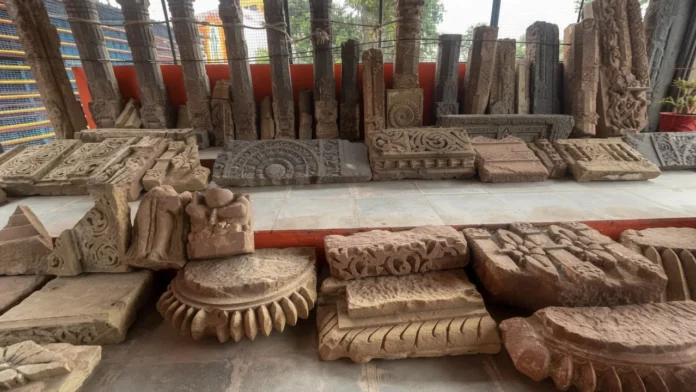
The court examined the report prepared by the Archaeological Survey of India (ASI) in 2003 after the scientific excavation of the disputed site, together with the objections raised by all parties against that report.
The ASI excavation, conducted under the direction of the Allahabad High Court in 2003, became one of the most significant pieces of evidence. The excavation revealed the remains of a large underlying structure beneath the disputed site. According to the ASI, the structure was “non-Islamic” in nature and displayed features associated with a pre-existing religious building. While the ASI did not state that it had discovered the birthplace of Bhagwan Ram, its findings indicated that a substantial non-Islamic structure had existed before the construction of the disputed structure. The SC accepted the ASI report as a scientific piece of evidence and found no material reason to reject its conclusions.
The unanimous five-judge Constitution Bench also considered historical records and travellers’ accounts that we also found in Jain’s book. Writings of travellers such as Joseph Tieffenthaler, colonial gazetteers and official reports consistently recorded the Hindu belief that the site was the birthplace of Bhagwan Ram and referred to continuous Hindu worship in and around the disputed premises. These records were not treated as conclusive proof of ownership but were considered relevant in understanding the long-standing nature of worship at the site.
Another important category of evidence comprised the revenue and administrative records of the British era. The court analysed official records prepared during different periods to understand possession and the character of the property. Alongside these records, it evaluated the testimony of numerous witnesses from both sides, carefully assessing their credibility against documentary and archaeological evidence rather than accepting oral statements in isolation.
After examining all these materials together, the court concluded that no single piece of evidence was decisive on its own. Rather, it was the combined weight of archaeology, historical records, documentary evidence and continuous patterns of worship that guided its findings on the title.
The SC unanimously held that the Hindu parties had established a better possession and title claim over the disputed land than the competing claims before it.
The court found that the evidence demonstrated a consistent pattern of Hindu worship, particularly in the outer courtyard and, over time, even within the disputed premises. At the same time, it held that the Sunni Central Waqf Board had “not produced sufficient evidence to establish exclusive and continuous possession” of the inner courtyard in a manner that would legally defeat the competing claim.
The court also rejected the claim of the Nirmohi Akhara. It held that the Akhara’s suit was barred by limitation and that it had failed to establish the legal rights it claimed as the shebait (manager) of the deity. Consequently, the Akhara was not granted ownership, although the court later directed that appropriate representation be considered in the trust created for temple management.
Importantly, the court clarified that the judgment was based on constitutional principles and the law relating to civil property disputes, not on religious preference.
One of the biggest criticisms of the judgment is the belief that the court rewarded illegal acts. A careful reading of the judgment, however, shows that it took the opposite view.
The SC unequivocally condemned the events of December 1949, when idols were placed inside the disputed structure, describing them as an unlawful act that disturbed the existing status quo. It similarly condemned the demolition of the disputed structure on 6 December 1992, calling it a serious violation of the rule of law.
However, the court made it clear that these illegal acts did not determine the outcome of the title suit. The title had to be determined independently through historical evidence, documentary records, archaeology and settled legal principles.
This distinction became one of the defining features of the judgment: the court condemned the illegality but refused to allow illegality to become the basis of legal ownership.
Having determined the question of title, the court then turned to the question of relief. The SC attempted to balance historical evidence, constitutional values and equitable justice.
While recognising the Hindu parties’ title over the disputed land, the court also acknowledged that the Muslim community had suffered the loss of a mosque. To ensure that justice remained consistent with constitutional values, it directed the government to allot five acres of suitable land to the Sunni Central Waqf Board for the construction of a mosque.
This relief was granted under Article 142 of the Constitution, enabling the court to do complete justice between the parties.
The Ayodhya judgment was the culmination of a dispute that had travelled through 134 years and decades of litigation. It was undoubtedly one of the most sensitive cases ever decided by an Indian court. Yet, the SC’s approach remained rooted in the Constitution and the law.
The judgment can be debated, criticised or defended. But it cannot accurately be described as a judgment delivered merely on religious belief. The SC treated the case as a civil title dispute, examined an extensive evidentiary record and resolved it through established principles of law.