

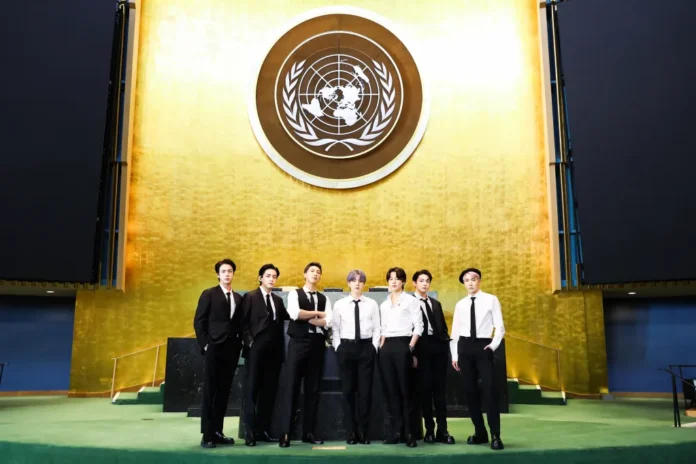
In September 2021, BTS stood before the United Nations General Assembly—not as entertainers invited to perform, but as representatives of a generation. Their appearance was more than symbolic; it was diplomatic. Within a single generation, South Korea had transformed itself from a country forced to seek an IMF bailout during the 1997 Asian financial crisis into one of the world’s most influential cultural powers. The engine of that transformation was neither military strength nor economic coercion. It was soft power, delivered song by song, drama by drama, skincare tutorial by skincare tutorial, through the screens of ordinary people who never imagined themselves participants in geopolitics.
We are living through a profound shift in the way influence operates. The traditional playbook—governments funding cultural institutes, state broadcasters shaping international opinion, embassies organising film screenings and cultural festivals—has not disappeared, but it is no longer sufficient, nor even primary. Today, a teenager in Lagos can discover Korean cinema without ever encountering an official cultural programme. A yoga instructor in Mumbai can reach millions without government sponsorship. A journalist in Delhi can shape readers’ perceptions of India in London, Nairobi and São Paulo with little more than a laptop, an internet connection and a compelling story.
In all, soft power has not simply expanded; it has been democratised.
When the American political scientist Joseph Nye introduced the concept of soft power in the late 1980s, he defined it as the ability to shape the preferences of others through attraction rather than coercion. Nye’s formulation remains remarkably durable, but the world in which it was conceived has changed beyond recognition. He envisaged states projecting influence through universities, cultural exchanges, diplomacy and international broadcasting. What he could not have anticipated was how soft power would transform that landscape.
A single viral video, fan translation, independent podcast or investigative report can now reach audiences once accessible only to governments or multinational media organizations. No country illustrates this transformation more vividly than South Korea.
In the wake of the 1997 Asian financial crisis, the Korean government made a calculated bet: invest heavily in the creative industries. The Ministry of Culture, Sports and Tourism channelled resources into film, television, music and gaming. Yet what the state planted, its citizens nurtured into something far greater than any policymaker could have anticipated.
The Korean Wave, or Hallyu, began quietly. Romantic dramas such as Winter Sonata built devoted audiences across East and Southeast Asia in the early 2000s. Then came K-pop: meticulously produced, multilingual and designed for global audiences. Entertainment companies such as HYBE, SM Entertainment and YG Entertainment created training systems that produced not merely performers but global cultural brands. Groups such as BTS and BLACKPINK did more than sell music; they cultivated communities whose loyalty transcended language, geography and politics.
The numbers illustrate the scale of the transformation. Korean cultural exports grew from roughly US$1.5 billion in 2010 to more than US$11 billion by 2022, spanning music, television, film, gaming and cosmetics. K-beauty alone accounted for more than US$9 billion in exports, reshaping skincare routines from Paris to Jakarta not through conventional advertising campaigns, but through YouTube tutorials, beauty influencers and consumer recommendation networks.
Japan presents a different model of soft power. Its cultural influence emerged less through deliberate state strategy than through the enduring appeal of its creative industries.
Anime and manga had become global phenomena long before governments began treating them as diplomatic assets. From Dragon Ball and Akira to Attack on Titan and Demon Slayer, Japanese storytelling attracted international audiences through cultural magnetism rather than official promotion. By 2022, the global anime market was valued at approximately US$25 billion, with forecasts suggesting it could exceed US$60 billion by the end of the decade. That the spread of manga tells a similar story. France is now the world’s second-largest market for Japanese comics outside Japan itself.
Similarly, if South Korea exemplifies the deliberate cultivation of soft power and Japan demonstrates its organic evolution, India represents something altogether more complex: a civilisation whose soft power long predates the modern nation-state. Civilisation whose cultural influence has travelled across continents for millennia, through religion, philosophy, trade, language and migration.
Sanskrit influenced literary traditions across Southeast Asia. Buddhism travelled from the subcontinent to East and Southeast Asia, reshaping cultures far beyond India’s frontiers. Indian mathematics transformed scientific thought in the Arab world before reaching Europe, while merchants carried textiles, spices and artistic traditions across the Indian Ocean. Cultural influence has always accompanied commerce.
Modern India continues that tradition through different media. Bollywood remains one of the world’s largest film industries, producing hundreds of films every year for audiences that stretch well beyond the Indian diaspora. Its reach extends across the Middle East, Central Asia, Africa and parts of Latin America. For example, in northern Nigeria, Hindi films dubbed into Hausa (a Chadic language spoken primarily by the Hausa people in Niger and Nigeria) have enjoyed immense popularity for decades.
In the same way, yoga represents another dimension of India’s cultural influence. Practised by hundreds of millions of people across the world, it has evolved into a global wellness movement while simultaneously provoking debate within India about cultural appropriation, commercialisation and the reduction of a rich philosophical tradition to a form of physical exercise. The United Nations’ adoption of 21 June as the International Day of Yoga, following an Indian initiative, gave diplomatic recognition to a practice that had already become a global cultural phenomenon. In many respects, the resolution acknowledged an influence that had long since taken root independently of governments.
Culture, however, is only one medium through which influence now travels. Journalism is another and often ignored medium in debates and discussions.
For much of the twentieth century, the international news agenda was dominated by a relatively small group of Western broadcasters. The BBC exercised immense influence over how global events were framed and understood. That concentration of authority has weakened considerably. Perhaps the clearest example of journalism functioning as an instrument of soft power is Al Jazeera. Established by the Qatari government in 1996, the network transformed media across the Arab world by providing sustained coverage of issues often underrepresented elsewhere, including the Israeli–Palestinian conflict, the wars in Afghanistan and Iraq, and the Arab Spring. Whatever criticisms have been levelled against it, Al Jazeera fundamentally altered assumptions about who has the authority to narrate global events.
Its influence became particularly evident during the 2017 Gulf crisis, when Saudi Arabia and several of its regional allies demanded the closure of Al Jazeera as one of the conditions for ending the blockade of Qatar. The episode illustrated a broader reality: journalism itself had become a strategic asset.
Yet attraction has its darker side.
Soft power is often presented as inherently benign, but influence can become dominance when it flows overwhelmingly in one direction. Hollywood’s global reach did not simply entertain audiences; it also normalised particular assumptions about individualism, consumerism and social aspiration. K-beauty has transformed skincare worldwide, but it has also reinforced narrow beauty ideals. Yoga’s commercial success has brought Indian philosophy to millions while simultaneously stripping many practices of their original intellectual and spiritual context.
The question is no longer simply which country possesses the greatest soft power. It is who gets to tell the story, in whose language, through which platforms, and to what end. In an age when a teenager in Lagos or a yoga instructor in Mumbai can shape global perceptions with nothing more than a smartphone, cultural influence has slipped the bonds of state control. Understanding this shift is no longer an academic exercise — it is the key to grasping how power itself now works.