

Once every year, at Kamakhya, one of the most profound celebrations of womanhood unfolds. The doors of the temple close. Not because of the disaster. Not because something has gone wrong. They close because the Devi is menstruating: a reminder that the very power that creates, nurtures, and sustains life is divine. For three days, Devi Maa is given rest. The sanctum remains sealed, prayers pause, and devotees wait patiently outside.
There is no outrage over the closure, no demand that the rituals should continue without any break. There is only reverence for a natural process which is so deeply connected with creation itself. Following this, when the doors reopen on the fourth day, thousands gather in celebration. Among the most sacred offerings is the Rakta Vastra, a piece of red cloth associated with the Devi’s period of seclusion. Devotees receive it with folded hands, preserving it as a blessing from Devi Maa.
Pause for a moment and consider what this signifies. At Kamakhya, menstruation is neither hidden nor spoken of in whispers. It is not treated as something shameful that must be concealed. Instead, it is acknowledged as part of the sacred rhythm of life itself. The very process through which creation becomes possible is honoured in the form of the Devi.
This is why pilgrims have travelled across the subcontinent for centuries to witness the Ambubachi festival. They come not despite the Devi’s menstruation, but because of it. In Kamakhya, the menstrual cycle is inseparable from the idea of Shakti (the divine feminine power that creates, nourishes, transforms, and sustains the universe).
The origins of Kamakhya are preserved through multiple sacred traditions, each revealing a different facet of the Devi and the land she inhabits. The most widely known story begins with Devi Sati (consort of Bhagwan Shiv and the daughter of Prajapati Daksh). After she immolated herself at Daksh’s sacrifice, Bhagwan Shiv, consumed by grief, wandered the cosmos carrying her body and performing the Tandav. To prevent creation from collapsing under the force of his sorrow, Bhagwan Vishnu released the Sudarshan Chakra.
As Devi Sati’s body was divided, its sacred fragments fell across the subcontinent, giving rise to the Shakti Peethas, sites where the presence of the Devi Maa would remain eternally alive. At Nilachal Hill in Guwahati, it is believed that her yoni fell to earth. Thus, Kamakhya emerged as a centre of creation itself, where the feminine source of life became reverence rather than concealment. The Kalika Purana regards Kamakhya as the foremost of the Peethas. Another legend, as per the same puran, describes Nilachal as a place sanctified by the union of Shiv and Shakti, where the cosmic principles of consciousness and energy came together in divine desire.
Another tradition links the region to Kamdev, the god of love, who regained his lost form here after being reduced to ashes by Bhagwan Shiv. Because Kam recovered his rupa at this sacred site, the land came to be known as Kamrupa. In gratitude, he is said to have established the earliest shrine to the Devi. The legends continue with Naraka, the ancient ruler of Pragjyotishpura, who became a devotee of the Devi and is credited in local traditions with developing the sacred hill and its pilgrimage routes. Other accounts associate Kamakhya with the Mahavidyas and the great Tantric traditions, portraying Nilachal not merely as a temple hill but as a vast sacred landscape infused with Shakti.
The texts never insist that only one of these stories is true.
Instead, they preserve many memories of the same sacred place. Whether understood as the site of Devi Sati’s fallen yoni, the land where Kamdev regained his form, or the meeting ground of Shiv and Shakti, every tradition points toward the same idea: Kamakhya is where creation, fertility, desire, and the power of the Divine Feminine converge. Nothing else.
In the Assamese month of Ahar (June), the Kamakhya Temple closes its doors. The Devi is menstruating. Preparation begins days before. The sanctum is draped with a cloth, the angavastra over the yoni mandala. For three days, no worship is performed and devotees wait patiently outside, allowing Devi Maa to have her period of rest. On the fourth day, known as Shuddhi, the priests ceremonially retrieve the angavastra with great reverence. The yoni is ritually bathed. Sacred rites are performed and the temple reopens.
What the pilgrims receive is the angavastra that is cut into small pieces and the angodak (अंगोदक), the spring water. The angavastra is considered the most auspicious prasad in the Kamakhya complex. It is tied around wrists or necks, kept in prayer rooms, and carried across the country. It is understood to carry the living Shakti of the Devi in her most concentrated form, the creative power of the cosmic feminine at its peak.
During the three days of closure, the temple grounds are not empty. They are filled. Tantric sadhus and Aghori ascetics, some of whom live in forests and caves for the other 362 days of the year, emerge and gather. Intensive sadhanas are performed in the precincts. Farmers across the Brahmaputra valley observe the closure literally: they do not plough. They do not dig. The same logic that governs the temple governs the fields. That Maa Kamakhya is also Devi Maa. Her menstruation is the earth’s menstruation. You do not disturb what is preparing to give you life.
Similarly, across Bharat, one finds traditions that recognise menstruation not as a source of shame but as a manifestation of fertility, renewal, and creative power.
For instance, Raja Parba, celebrated in Odisha, is one of eastern India’s most distinctive festivals. Celebrated with the arrival of the monsoon, the festival is dedicated to Bhu-Devi. The very name Raja derives from rajaswala: a menstruating woman. The belief underlying the festival here, too, is the same as Kamakhya: the earth herself is menstruating and must be allowed to rest. In a nutshell, the land that feeds humanity is treated not as an inert resource, but as a living, fertile mother.
The festival transforms this period of rest into a celebration. Women wear new clothes, adorn their feet with alta, gather around swings suspended from trees, sing traditional songs, and participate in rituals that have been passed down for generations. The atmosphere is not one of restriction but of festivity. When the period of seclusion ends, Vasumati Snana marks the ceremonial purification of the Dharti Maa. Only then does cultivation resume, symbolizing the return of fertility to the land after a period of sacred rest.
The Bhu-Devi is invoked through many names—Basudha, Prithivi, Thakurani, Harchandi, Draupadi, and others. Yet beneath these diverse forms lies a common idea: the creative principle that sustains life deserves reverence.
Likewise, in southern India, the Chengannur Mahadeva Kshetram in Kerala’s Alappuzha district—believed to be one of the oldest temples in the state—is a Shaiv temple. Its presiding deity is Mahadev, represented in the form of a lingam, while his consort, Bhadrakali (Parvati), stands behind him. The temple has an everyday ritual. Every morning, the head priest removes the nirmalyam (previous day’s decoration of the deity) and the white udayada (petticoat) and that is brought to the senior woman of the Thazhamon family, the hereditary custodians of the temple’s inner rites for confirmation of menstruation. Once confirmed, the Devi’s sanctum is sealed. Her murti is moved to a smaller room in the inner courtyard and given rest for three days. Women of the temple sleep outside her door at night to keep her company, just as women keep company with a menstruating girl in her seclusion. On the fourth day, the Devi is taken in procession on a female elephant to the Pamba river and there women perform her ritual oil bath and bring her back in state, circling the temple together three times before she re-enters her sanctum.
Then there is the story of Sir Thomas Munro, a British official, who is said to have mocked the belief that the Devi undergoes her annual cycle and subsequently withdrew the grants that supported the festival’s observance. According to tradition, shortly thereafter, his wife began suffering from severe and unexplained bleeding that physicians were unable to cure. Disturbed by the situation, Munro restored the grants and established a trust to ensure the festival’s continued observance. The story concludes with his wife’s recovery.
Whether approached as history, memory, or sacred tradition, the narrative continues to be told as part of the temple’s living heritage. Significantly, it is not presented as an argument or a warning, but simply as one of the many stories through which devotees express the Devi’s enduring presence and power.
Among the Tulu-speaking communities of coastal Karnataka, the same idea appears in the festival of Keddasa. Observed during the last days of the Tulu month of Puyintel (roughly January–February), Keddasa marks the annual menstruation of Bhu-Devi.
For three days, the earth is believed to be resting. Agricultural and earth-breaking activities are avoided: fields are not tilled, trees are not cut, wells are not dug, and the soil is left undisturbed. The pause is not merely practical; it is ritualised respect for the living earth. On the fourth day, known as Keddasa Naalku, purification rites are performed, prayers are offered, and normal activities resume, symbolizing the restoration of the earth’s fertility and creative energy.
If Ambubachi were the only example, one might dismiss it as a local peculiarity of Assam. But it is not.
Across Bharat, separated by thousands of kilometres, different languages, and distinct cultural traditions, we repeatedly encounter rituals that associate menstruation, fertility, and creation with the sacred. The names change, the stories change, and the rituals change, but the underlying symbolism remains remarkably consistent.
In Malabar, the earth itself was believed to rest during the harsh summer months until the arrival of the first rains revived her fertility. Brahmacharini, worshipped on the second day of Navaratri, is associated with the transition into womanhood and feminine maturity. In Dharmashastric traditions, Bhuvaneshwari is invoked in rites connected with menstruation and menarche.
If one wishes to understand how deeply fertility and feminine creative power were embedded within the sacred imagination of India, it is worth looking not only at texts and rituals but also at the images carved into stone.
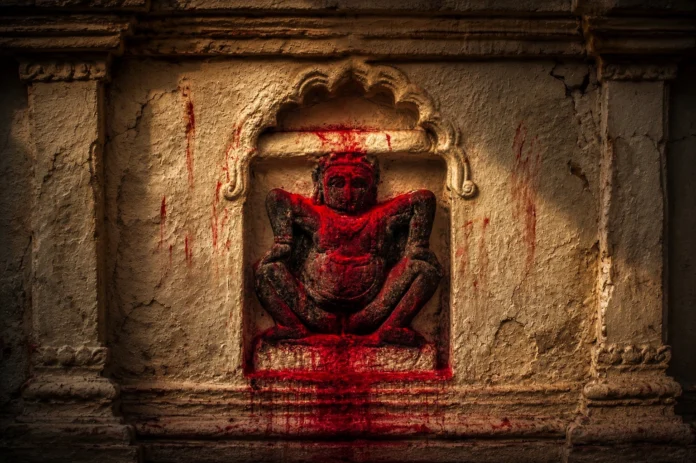
Among the most remarkable is Lajja Gauri, an ancient Devi whose sculptures have been discovered across the Deccan, particularly in Karnataka, Maharashtra, Andhra Pradesh, Telangana, and Gujarat. She is usually depicted in a birthing posture, her reproductive organs prominently displayed, often replacing the head with a lotus or a vessel, symbols associated with abundance and creation. The imagery is unmistakably centred upon fertility, generation, and the power through which life emerges into the world.
In the northeastern Indian state of Assam, the occasion is commemorated through Tuloni Biya or Xoru Biya, literally a ‘small wedding.’ After a period of seclusion, the girl is ceremonially bathed, dressed in new clothes, and honoured before relatives and friends. In Tamil Nadu, Manjal Neerattu Vizha transforms the occasion into a festive celebration marked by turmeric baths, silk garments, jewellery, blessings, and community participation. Andhra Pradesh and Telangana observe similar customs through Peddamanishi Pandaga, while Karnataka preserves traditions such as Ritu Kala Samskara and Ritu Shuddhi. Kerala’s Thirandukalyanam likewise marks the transition with ritual baths, feasts, gifts, and prayers.
Therefore, Hindu traditions do not speak with a single voice on menstruation. Different communities developed different customs to celebrate menstruation. Indeed, sometimes those customs appear contradictory, too and anthropological studies have also shown that women themselves describe menstruation through multiple frameworks simultaneously: one emphasizing restriction, another emphasizing protection, rest, or sacred power.
Modern discussions frequently present only one side of the picture, the restrictions, the prohibitions, the social discomfort, while overlooking the equally real traditions of reverence, symbolism, and ritual significance. The temples are rarely mentioned. The festivals are rarely mentioned. Lajja Gauri is rarely mentioned. Kamakhya is rarely mentioned. A civilizational tradition that contained both veneration and restraint is often portrayed as if it contained only stigma.
The result is not necessarily a false narrative, but an incomplete one. And when complexity is stripped away in favour of a single narrative, understanding gives way to caricature.
There I say: a tradition should be examined in its entirety, its strengths, its contradictions, its reverence, and its restrictions, not reduced to only the aspects that fit a contemporary argument.
Editor’s note: The books referred to for writing this article include The Sabarimala Confusion – Menstruation Across Cultures: A Historical Perspective by Nithin Sridhar and Ṛtu Viḍyā: Ancient Science Behind Menstrual Practices by Sinu Joseph.