

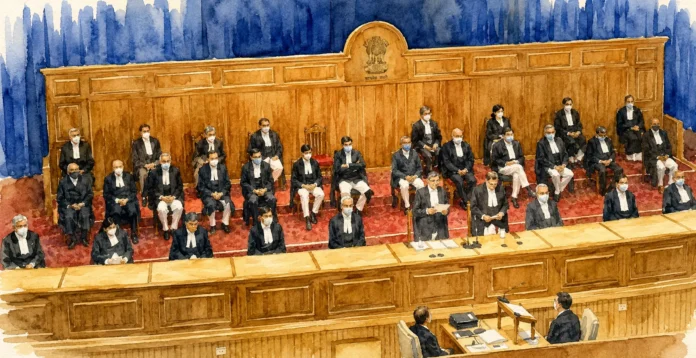
Tell me, what can happen if, as a young advocate, a bundle of files gets dropped from your hands while a hearing is going on? ‘Be careful, young counsel’ or ‘Don’t worry, it’s fine; these things happen’ – that’s what the judge would say, right? Naah. The minimum that the judge would say is: ‘You think you are a great senior advocate?’ and ‘Not having at least 10 years standing and you will throw the bundle?’
If you think I’m cooking up stories. Please. It’s the sitting judge of the Andhra Pradesh High Court, Justice T Rajasekhar Rao, who made these remarks to a young counsel on 5 May 2026.
The story didn’t end with remarks. Justice Rao ordered the 24 hours custodial detention—meaning being taken away by the police and locked up—of the advocate. However, the order was withdrawn later through an amicable settlement, and a request by the bar association. But I ask: what was the need of doing this at all? Especially, when alternatives and those, too, respectable and humane ones existed before the judge? For example, he could have counselled the young advocate on ‘courtroom etiquette.’ He could have issued a ‘contempt notice’. If he wished to escalate further, a reference to the Bar Council for professional misconduct was always an option. Instead, an officer of the court (the young advocate) was ordered to be hauled out of his own workplace in custody, not for a proven act – but for a misread one. There is no rung on the ladder that leads to handcuffs.
One thing that struck me, to the core, as an individual who wishes to practice law after two years, was that none of the advocates present in that courtroom protested the act. Instead, two of them stood as named witnesses to the entire episode. It is one thing for an institution to fail you. It is another to watch your own peers look away while you beg.
That the advocate had pleaded for forgiveness. Read for yourself: ‘Your Lordship, I have some pain here, lordship’, ‘Sorry, I am begging (with folded hands)’, ‘Begging for your grace, lordship’, ‘I am begging for your grace, your lordship’ and ‘Begging for your grace.’ Yet, nothing worked.
It happened because of a reason no one debated when the clip of this official interaction went viral. The reason was ‘hierarchy.’ Hierarchy that got reflected in the two remarks made by the judge. Repeating for your ease: ‘You think you are a great senior advocate?’ and ‘Not having at least 10 years standing and you will throw the bundle?’ I wonder, if the concern was courtroom discipline, why did seniority enter the picture at all? Also, does the prohibition against throwing files lift for a senior advocate? The implicit logic in those words is damning: that the same act carries a different price depending on who you are.
To me, this outburst was not about preserving the dignity of the court. It reveals precisely where a young advocate stands in the courtroom hierarchy. At the bottom. Where the rules are enforced selectively. And I was so confounded by the words said from the bench that day. Precisely speaking: not the measured language of disciplinary authority, but the unguarded reveal of a mindset that had confused the weight of the robe with the license to humiliate.
The humiliation that can be sensed in the judge’s own words when the advocate was asking for forgiveness. ‘Now you will get lots of pain’, said the judge. I find it genuinely difficult to process that these words were said by a sitting High Court judge to a man already in submission, citing physical pain. Or, for that matter, ‘Go file an appeal; Go make a dharna at the Bar Council.’ These were not the words of someone uncertain about the propriety of their conduct. These were the words of someone operating from the quiet certainty that they cannot be touched, that the robe is armour enough. That I possess, the fearlessness of power.
While these words, spoken in an open court, were enough to shatter a young lawyer’s sense of his own place in the profession, what followed in the name of resolution, from the very institution a lawyer is supposed to be able to look to, was in many ways more troubling.
The Andhra Pradesh High Court Advocates’ Association (APHCAA) issued a five point resolution letter describing the resolutions passed by the Bar Council of India (BCI) and Supreme Court Bar Association (SCBA) as ‘hefty,’ ‘factually incorrect,’ and ‘based solely on social media content,’ on the grounds that the matter had already been amicably resolved and thus warranted no outside intervention. I mean, seriously?
The BCI had merely called the conduct ‘grossly inappropriate’ and sought the judge’s transfer, along with withdrawal of judicial work. And SCBA had expressed a ‘deep shock’ and described the episode as a grave threat to judicial temperament. After this, you tell me, what was ‘hefty,’ ‘factually incorrect,’ or ‘based solely on social media content’ in this at all?
All I can say is this: a state bar association instructing the statutory body, the Bar Council of India, on where it may and may not intervene, while simultaneously suppressing a matter of this gravity under the guise of mediation, is not institutional responsibility. It is institutional protectionism.
Hours after the letter was circulated, approximately 300 young advocates of the High Court issued a counter-statement, making clear that APHCAA’s letter did not speak for them. On the claim of amicable resolution, they were unambiguous: ‘We fail to fathom what could have been an amicable settlement pertaining to the incident.’ They had not been consulted. They had not settled. They had simply been spoken over.
They also revealed something that requires no embellishment: during the mediation process, an elected member of the Bar Council of Andhra Pradesh explicitly suggested that the young advocate should kneel before the judge and, if necessary, be slapped, to satisfy the court. If the institution that is supposed to be your first shield is busy sharpening the blade, one must ask: who, exactly, is the bar serving?
After all this circus, the last remaining hope rested with the highest court of the land. The Supreme Court did take cognisance, and for a moment, it seemed like the matter would be examined with the seriousness it deserved.
But what arrived instead was another closure. The SC disposed of the petition observing that ‘the incident in question does not warrant any further action at our end,’ citing an ‘amicable resolution (mutual resolution without escalation),’ ‘the young counsel’s statement that he harbours no apprehension in continuing his professional duties,’ and attributing the escalation, in part, to ‘the dissemination of decontextualised video clips.’
Decontextualised, like seriously? The ‘context’ the Supreme Court referred to was a mere disagreement over a precedent but how does it justify a single word the judge said? None of it finds cover for the judge’s words. And providing context for a fire does not mean the fire did not burn.
I mean, what further context was needed when the Supreme Court itself held that the incident was ‘an occurrence which was not attended by any deliberate intent’? It was the judge who construed it otherwise, and if the court’s own findings say the advocate did nothing deliberate, then the blame for what followed cannot be laid at the door of a (so-called) decontextualised video clip.
The court referred to this whole incident as a ‘misunderstanding’. I ask, in what sense was this a ‘misunderstanding’? That a judge misread a situation and ordered an advocate to custody from his own workplace? That the counsel had to beg, literally, with folded hands, for the grace of a man who had already decided to make an example of him?
That the court’s reliance on the advocate’s statement that he harbours no apprehension of fear does not close this matter. What happened with him was seen by everyone, maybe the SC, too. Yet, none said the basic: ‘What happened was wrong.’ It seems, asking for the basics has become the most difficult thing of the 21st century. Whatever, staying neutral when one side is clearly at fault is not neutrality. It is a quiet legitimisation of the wrong.
The wrong that could be seen in the actions of Justice Abhijit Gangopadhyay of the Calcutta High Court. When, in December 2023, he ordered the immediate arrest of an advocate from within his own courtroom directing that his robes be stripped and that he be sent to civil prison, without any opportunity of hearing, simply because the advocate had cited a division bench order that modified the judge’s own ruling. Or when, in April 2026, Ms Garima Jindal, Judicial Magistrate of First Class, at the Rohini District Court, told an advocate, in an open court: ‘Kutte ki tarah mat bhonk (don’t bark like a dog).’ Or when the Karnataka High Court, in September 2024, witnessed these sexist remarks by Justice V Srishananda: ‘Wait amma. Why are you responding? You know everything about him. If questioned tomorrow, you will also tell what colour undergarment he wears,’ just because a woman advocate had responded to a question directed at opposing counsel. These incidents are not aberrations. They are a pattern. For every incident that reaches public discourse, countless others are absorbed quietly by advocates who have learned that speaking up costs more than staying silent.
As an aspiring advocate preparing to one day stand in these same courtrooms, I find myself asking a question I did not expect to be asking this early: what exactly am I walking into? It is long overdue that the legal fraternity, bar and bench alike, confronts the culture it has collectively permitted to calcify. The relationship between the bar and the bench is not, and has never been, one of subject and sovereign. It is a relationship of mutual professional respect, and when that respect flows only in one direction, the bench stops being a seat of justice and becomes a sovereign with a stick.
Part of the answer lies in sensitisation, not as a remedial afterthought, but as a structural commitment. The bench must be made to reckon, through training, through oversight, and through genuine accountability, with the human cost of how power is exercised in a courtroom. That reckoning has to be built into the system, not left to the goodwill of individuals.
I believe the dignity of the court is not enhanced when a lawyer is made to beg for grace in open court (court accessible to the public and the press) and is still ordered to custody. It never was, and it never will be.
The questions this pattern demands are not abstract. Why are judges who conduct themselves this way consistently shielded by the institution? Why does accountability always land on the wronged party as a burden to move on, rather than on the erring one as a consequence to face? And why does the system seem more invested in restoring the appearance of order than in asking whether that order was ever fair to begin with?
These are not rhetorical questions. They are the ones young advocates carry into every courtroom every morning in silence. Until the system finds the honesty to answer them, every settlement is just another way of saying: this is how things are, and this is how they will remain. The system must understand that a wound dressed in procedure still bleeds.