

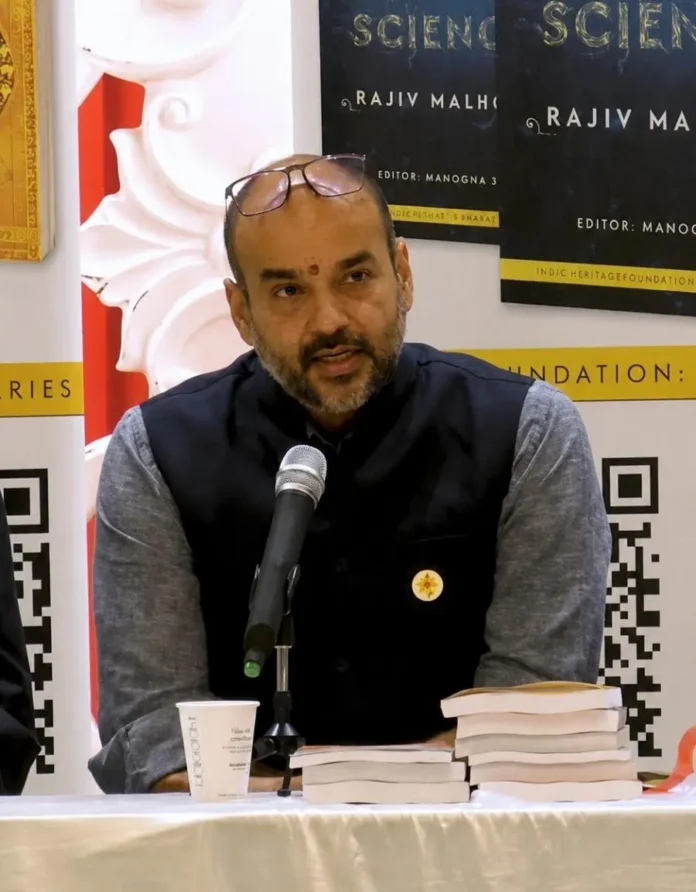
Introduction by S Shiva: when I was sitting in front of Rahul Dewan, the founder of Sangam Talks, the only thing coming into my mind was that if he were in the left, he would have got so much recognition for his work. So many interviews, so much media presence, so much of so many things. However, he is in the right. Yes, I was grateful, but I wanted to know the why of it and yes, what made him stand against those who had power in creating the narrative. Yet, he chose not just to stand against them, but on his own.
I wasn’t aware of his name a few years back. Of course, he maintained a minimal presence. But my becoming aware of his name brought one other name as well. It was the Rs 1000 crore Hindu Fund. As far as I remember, I first heard of this term in the 2025 Swarajya Conclave, during which Dewan presented the fund as a strategic response to civilizational challenges facing Hindu society in India. It appeared to me that he is some billionaire who has a lot of money and so he is donating.
But this interview changed things completely, at least for me. He is no billionaire. He is a person who started his journey from a job, then pursued his business and working for dharma was his final stop. I am unable to forget his line: ‘I couldn’t travel on two boats. It could be either business or dharma – I chose dharma.’
I found him to be a calm individual with precision. He didn’t hedge when I asked: ‘What’s your end goal?’ and he was quick to reply within a second: ‘A constitutional Hindu state’. Also, what kept him stable was something that I wanted to ask him. And I must admit, he was honest. This and much more in this conversation. Happy reading.
Isha: Where are you originally from? Could you describe your journey from software engineer to Srijan Foundation?
Rahul Dewan: We are Punjabi Khatri. My grandparents—both paternal and maternal—came to India from Sargodha, Pakistan, at the time of Partition. I was born in Delhi itself and completed my schooling and college here. In 1997, I briefly worked for an American company, then worked for a Danish company. I started my own business in 2001. My father wanted to bring me into our electronic component trading business, and for a long time I worked at the shop too.
But one day, I told my father I could not continue doing that and started my own business again. It was a time of struggle for me. In 2022, I sold my company ‘Srijan Technologies,’ which at that time had around 600 employees and had offices in the US, Australia, and Singapore. After that, I set up a foundation called Srijan Foundation.
Isha: What made you think of serving society?
Rahul Dewan: From my childhood, I was inclined toward social service and had the desire to serve the country. In 1999, I started a small school for a boy who worked in my home, and gradually, children of car cleaners and domestic workers from the neighbourhood also came along. A retired colonel from the colony, Colonel Ramakrishna, and a school principal joined us and started teaching the children for free. I remember Father Windy used to live near our house. He was Christian, but not a missionary. Initially, the school used to run from his house. Later, when the number of children grew, we started ‘School of Happiness’ in Kishangarh village near Vasant Kunj. And it is still running.
S Shiva: Is any child from this school still connected with you?
Rahul Dewan: There is Furkaan. I remember an interesting incident related to him. When he was in second or fourth grade, he made a painting of Lord Krishna, but his family told him it was kufr. Even so, he continued pursuing what he loved, and we encouraged him throughout. Furkaan is now the editor of our video team.
S Shiva: What was the one moment that changed your ideological outlook?
Rahul Dewan: The shift began after I started Sangam Talks. Many of my left-leaning friends stopped speaking to me. Around 2013–14, I read Writer Sanjeev Sanyal’s book India’s Rise After a Thousand Years of Decline, followed later by Land of Seven Rivers. The first book dismantled Gandhian economics for me, while the second made me realise how much of Indian history we had never been taught. That fundamentally changed the way I understood things.
Isha: What challenges did you face when you started speaking up for the nation and for Hindus?
Rahul Dewan: Around 2013–14, when the political climate in India was changing, I was very active on social media. As I began speaking up for India and Hindus, many of my own friends and acquaintances started labeling me a Hindu nationalist, a ‘Sanghi’ (a member of the Rashtriya Swayamsevak Sangh), and anti-Muslim.
S Shiva: What kept you going? And how did you cope with people leaving you?
Rahul Dewan: For me, India’s civilisation matters far more and so I resolved to work for it. Further, spirituality helped me manage things. I have been in search of the truth since my childhood. It was in 2008 that I found my guru in Sadhguru, and he helped me get stable in terms of spirituality.
As for who opposes me: it no longer matters.
S Shiva: Are you satisfied with your work so far? What is your ultimate goal?
Rahul Dewan: Yes, I am. My ultimate goal is the establishment of a ‘constitutional Hindu state.’ I am not talking about a Hindu ‘Rashtra’ – that we already are in spirit. But, we need to do this work within the Constitution too. The current constitution was not built on Hindu values; it does not advance Indian values. It weighs all religions on the same scale, treating all religions as equal – even those who themselves do not preach equality.
S Shiva: What do you see as the biggest obstacle to completing this work, and what is the solution?
Rahul Dewan: We face many challenges. The first is the Constitution, and the second is the Hindu leadership of the country. I am not talking about Hindu society as a whole. I am referring specifically to those who claim to work for Hindu interests.
Ask any of them what their ultimate goal is, and most will speak about ‘Hindu unity.’ But I do not believe Hindu unity, in the way it is commonly imagined, is possible. They argue that Hindus are divided by caste. But tell me: if I do not write ‘Dewan’ after my name, what should I write instead? Simply ‘Hindu’? How does that create unity?
In my view, such an approach only encourages Hindu society to forget its own history. Professor SN Balagangadhara has explained the concept of caste beautifully. He says castes are nothing but social groups in a society.
We need strong communities and strong social networks. For example, the Maheshwari community supports its own members by funding startups and businesses. I recently attended a Maheshwari gathering in Jodhpur and was struck by how organised and supportive the network was.
In the same way, every community should build systems that help and support its own members.
Isha: When the UGC issued its new rules, you played a major role in challenging them. What is your view of those rules?
Rahul Dewan: Yes. When I read the rules, I felt they needed to be challenged. If the intention was to prevent discrimination in universities, then why were General Category students treated separately? They, too, can face mistreatment.
I then spoke to Advocate Vishnu Shankar Jain, who told me he was also considering a legal challenge. After he filed the petition, the case came to be known as Rahul Dewan vs Union of India, although there were other petitioners involved as well.
Isha: How do you view the way Hindus are sometimes labelled as ‘good Hindus’ when they are passive and ‘Hindutva extremists’ when they are more assertive or defensive?
Rahul Dewan: If you are beating me and I am taking it silently, I am a good Hindu; but if I resist, protect myself, or strike back, I am called a Hindutva extremist. This perception has been created by certain people recently and is completely wrong. After all, how long can someone remain in defensive mode?
S Shiva: With so many daily battles and so much criticism, do you ever feel depressed or exhausted? What keeps you going, and what goals should Hindus focus on?
Rahul Dewan: No, I do not remain in a state of despair. I try to stay in Chardi Kala—a spirit of optimism and resilience. Of course, there are times when one feels tired. Every day seems to bring a new battle.
That is why we must remain focused on long-term goals. One such goal, in my view, should be the establishment of a Hindu state by 2047. But there must also be intermediate goals, such as ghar wapsi (religious reconversion to Hinduism).
For that to happen on a large scale, saints and spiritual leaders must speak up more actively. There needs to be a broader social movement, and religious conversions must be stopped.
S Shiva: What was the main purpose behind creating the Hindu Fund? How is it being used? Also, it is said that you have personally contributed nearly Rs 22 crore to these efforts. What made you invest so heavily in this work?
Rahul Dewan: After Sangam Talks began in 2016, people gradually started approaching me for help around 2017–18. A railway officer running a small school in North Delhi needed funding, so I helped him. Some people involved in cleaning the Ganga also needed financial support, and I began assisting them as well. That is how the fund slowly evolved.
Over time, I started allocating 7 per cent of my company’s profits for three years to the foundation, funding it entirely through my own company’s resources.
In 2022, I formally conceptualised the Hindu Fund: an organisation dedicated solely to supporting individuals and groups working for Hindu causes. My belief was simple: whether someone is building a gurukul, establishing an ashram, fighting against ‘love jihad,’ constructing a temple, or protecting cows in Kerala, such organisations should not struggle for lack of funds. That was the idea behind the creation of the Hindu Fund.
Its official name is the Hindu Network Foundation, which is registered as a Section 8 company. At present, decisions regarding funding and allocation are largely made by me, though there are other advisers involved. I hope the organisation eventually develops into a more institutional structure.
There is also a US-based entity called the Hindu Network Foundation USA. However, since we do not have FCRA clearance, those funds cannot currently be brought into India. At the moment, funding remains limited, and most contributions have come from me personally, along with support from one or two donors.
One of our current priorities is to build teams of lawyers across eight to ten cities. The idea is to support legal action wherever we believe anti-Hindu incidents occur, whether that involves filing FIRs or pursuing petitions in court.
For example, in Delhi, a follower of BR Ambedkar’s ideology recently made remarks about Hindu deities that we consider deeply objectionable, and we intend to pursue legal action. Similarly, Udhayanidhi Stalin has spoken about ‘ending Sanatan Dharma’ using language we view as inappropriate. In such cases, FIRs should be filed in multiple cities.
The second major objective is to build a long-term corpus or endowment fund. The idea is to invest that money in fixed deposits and financial markets so that the returns can sustainably support Hindu organisations. For example, with a corpus of Rs 1,000 crore, even a 10% annual return could generate nearly Rs 100 crore a year – enough to support organisations with funding of up to Rs 10 crore every month.
Right now, however, the fund remains very small—around Rs25–30 lakh—and there is effectively no corpus because most incoming money is immediately spent on ongoing work and funding requests.
S Shiva: You have spent the largest share of this fund, around Rs 6 crore, on legal activism. Why?
Rahul Dewan: Because we need to build a strong legal team. Our current goal is to challenge and ultimately abolish Tamil Nadu’s HR&CE (Hindu Religious and Charitable Endowments) Department. I have engaged a law firm to reinterpret Article 26. They are among the most renowned lawyers in the country. If we succeed, it could have implications for issues such as Sabarimala and the functioning of the HR&CE system in Tamil Nadu. More broadly, it could significantly advance efforts to free temples from government control. This kind of work takes time, but we are pursuing it actively.
Isha: There are many people who never contribute anything to the cause but constantly preach and even become abusive. We have seen some such tweets targeting you. How do you manage such beings?
Rahul Dewan: I do not take them seriously. People say many things about me on social media. I do not know how many of them are actually Indian Hindus and how many are Pakistani handles. I do not feel the need to constantly defend myself against them. There is no point in responding to any of them.
Many of them say I am a fraud. What should I do then? Publicly post my income tax statements? I will not do that. I tell them, ‘Brother, come. Come to Sangam Talks, come to the open webinar there and ask your questions.’ The Hindu Fund holds webinars, but these people never come.
S Shiva: Do you ever think that life was good working in the company, and you shouldn’t have taken this path?
Rahul Dewan: I couldn’t travel on two boats. It could be either business or dharma – I chose dharma. I believe we are carrying forward the struggle of Shri Guru Gobind Singh, Chattrapati Shivaji Maharaj, and all those who fought for us.
S Shiva: You must be aware that even Rs 1000 crore may not be enough for a cause of this scale. What do you think is the real challenge – funding, or something beyond money that determines the success of this movement?
Rahul Dewan: Yes, I agree. A thousand crore rupees should be nothing for this cause. I recently met an Infosys co-founder. He said that money is not the main problem in this work. The collective thinking and vision of Hindus will determine the direction of this movement. The lack of unity in thinking is the real problem.
I think that, if I were running a large enterprise right now, I could have spoken to many people on a different level. Right now, it is difficult to make them understand that this is truly a platform where all Hindus can come together and work as one.
S Shiva: Numerous crimes and acts of violence against Hindus occur daily, but the left-supported media does not cover them. What efforts do you make to bring such news to light?
Rahul Dewan: There is an initiative called Hinduphobia Tracker, run by journalist Nupur J Sharma and media entrepreneur Rahul Roushan. They document incidents affecting Hindus in a systematic and in the highest possible journalistic manner. I am glad to have been able to support their work financially.
I am also open to supporting similar initiatives. If anyone comes forward with a credible idea and clear potential, I am willing to extend support.
Isha: What is your understanding of the word ‘secular’ in the Indian context?
Rahul Dewan: If you are a Hindu, you are inherently secular. In a Hindu state, it does not mean everyone must follow Vaishnavism or that Shaivism is excluded. There are multiple paths within the tradition, and none is imposed as the only acceptable one.
However, the word ‘secular’ in the Constitution is interpreted to mean that all religions are equal. I disagree with that interpretation. It reflects Nehru’s ideological framing, which is simply incorrect.
In my view, a Hindu state, by its original definition, would itself function as a secular state.